

All articles · · By byJOOM
Choosing materials: how we decide what a building is made of
A building is, in the end, the materials it is made of. They decide how it looks, how it feels, how long it lasts, what it costs the planet and what it asks of the people who look after it. Here is how we think about them, and how we choose.
We choose for the project, not from a favourite list
There is no best material. Stone that is right for a courtyard in the desert is wrong for a lightweight rooftop pavilion. Timber that is ideal for a school in Surrey needs careful protection beside the sea. So we do not start with a palette. We start with questions, and the materials follow.
The questions we ask
- Use. Who uses the building, and how hard? A hospital floor must be sealed and easy to clean. A public plaza must take heavy feet and wet weather. A home can be softer and warmer.
- Place and climate. Heat, sun, humidity, salt, sand, frost, rain, wind and earthquakes all act on a material. A façade in Alexandria meets salt air. One in Manchester meets rain and frost. One in Aswan meets heat and dust.
- Character and aesthetics. Materials give a building its colour, texture and the way it takes light. We look for a palette that belongs to the place and ages with dignity, not one that looks new for a year.
- Durability and care. What will it look like in ten, thirty, fifty years? Who will clean, repair or replace it, and how? A material that can be repaired is almost always better than one that has to be replaced.
- Carbon and resources. How much energy and carbon went into making it, where did it come from, and can it be reused at the end? See embodied carbon and circular design.
- Health. Does it release anything harmful indoors? Does it help or harm comfort, daylight and acoustics?
- Supply and skills. Can it be sourced reliably, and are there builders nearby who know how to use it well? A local material and a local craft are usually better, cheaper and more durable than something shipped across the world.
- Safety, codes and cost. Fire, structure, accessibility and local approvals set hard limits. Cost matters over the whole life of the building, not only on the day it is built.
Stone that is right for a courtyard in the desert is wrong for a lightweight rooftop pavilion.
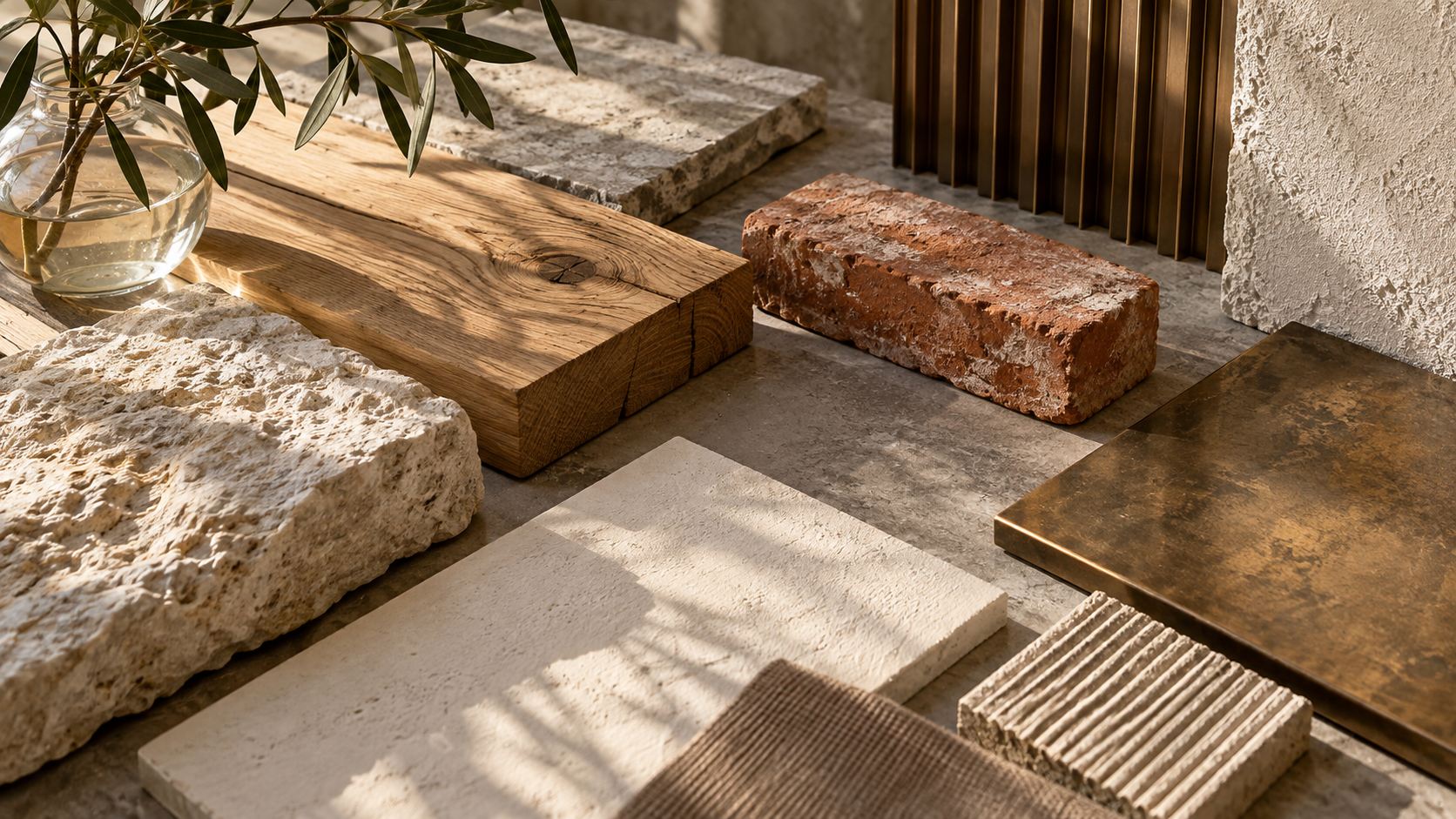
The materials we work with
Modern building offers a wide range. These are the families we use most, and what we look for in each. Every project needs specialist testing and advice before a final choice.
- Stone. Limestone, sandstone, travertine and granite. Long-lived, heavy and good at storing heat, so well suited to hot, dry climates. Quarrying and transport carry weight, so local stone is usually best.
- Brick and terracotta. Fired clay is durable, repairable and rich in colour and texture. It belongs to many UK and Mediterranean streets and weathers beautifully.
- Concrete. Strong, adaptable and fire resistant, but a major source of carbon. We use less of it, specify lower-carbon mixes where they are available, and expose it only where its finish is worth keeping.
- Steel and other metals. Efficient for long spans and slender frames. Steel can be reused, and recycled content is high. Bronze, copper and aluminium bring warmth and detail, but need protection from salt and corrosion.
- Timber. A renewable material that stores carbon while it is in the building. Engineered timber such as glulam and cross-laminated timber allows larger structures. It needs good detailing against moisture and fire, and responsibly sourced supply.
- Glass. Gives light, views and openness. Modern glazing can reduce heat gain and glare, and is combined with shading, so that transparency does not become overheating.
- Earth, lime and natural plasters. Rammed earth, adobe and lime are old techniques that are being rediscovered. They breathe, regulate humidity and are very low in carbon where the materials are local.
- Bio-based and recycled products. Insulation from wood fibre, hemp, cork or recycled content; flooring from linoleum; reclaimed brick, stone and timber. They reduce impact if they are well specified and well detailed.
- Lightweight and high-performance skins. Metal panels, perforated screens, fabric and ETFE foil roofs and high-performance membranes can shade, light and protect a building with very little weight.
How the choices change with the place
- In the desert, we use thick stone and masonry for thermal mass, deep shade, and perforated screens to filter light. Metals and glass need protection from dust and strong sun.
- On the coast, we choose materials that cope with salt and humidity: dense limestone, corrosion-resistant metals, robust coatings and careful drainage.
- In wet, cool climates, we favour brick, timber and slate or zinc roofs, with generous eaves and well-detailed junctions to keep water out.
- In a historic street, we take our colour, scale and texture from the neighbours, then add a contemporary layer in a clear, honest way.
Where the choice becomes design
Choosing materials is not a final step. It begins at concept stage, with options tested against the brief, the budget and the carbon target. It continues through samples, mock-ups and detail drawings, and it ends on site, where the quality of the work decides whether the idea is realised. A good palette is usually a short one: a few well-chosen materials, used with care, repeated with discipline.
What this means for you
When we work with you, we will explain the options, show samples, and set out what each choice means for cost, carbon, maintenance and appearance. Our aim is a building that is right for its use and its place, and that looks better with age.
See also: Sustainable materials and Embodied carbon.
Cite this article
Author: byJOOM. Choose a style and copy the citation.
- APA
byJOOM. (2026, October 15). Choosing materials: how we decide what a building is made of. byJOOM. https://byjoom.com/journal/choosing-materials/
- Harvard
byJOOM (2026) Choosing materials: how we decide what a building is made of. Available at: https://byjoom.com/journal/choosing-materials/ (Accessed: [date]).
- MLA
byJOOM. “Choosing materials: how we decide what a building is made of.” byJOOM, 15 Oct. 2026, byjoom.com/journal/choosing-materials/. Accessed [date].
- Chicago
byJOOM. “Choosing materials: how we decide what a building is made of.” byJOOM, October 15, 2026. https://byjoom.com/journal/choosing-materials/.