

All articles · · By byJOOM
Designing for the desert: shade, mass and screens
The desert is one of the hardest places to build and one of the best places to learn. The sun is strong, the days are hot, the nights can be cool, and dust and wind are never far away. A building that ignores this fights the climate and loses. A building that works with it can be comfortable with far less. Here is how we think about it, using our concept for AMTEC in Aswan as an example.
Start with the sun
In a hot desert the sun is the main thing a building has to manage. So we begin with its path, before we draw a plan.
- Orientation. We reduce glass on the east and west, where the low sun comes in hard, and open to the north and south where shade is easiest to control.
- Mass and shape. Compact, well-shaded forms gain less heat than sprawling ones, and buildings that shade each other and the spaces between them help everyone.
- Colour. Pale, warm surfaces reflect more heat than dark ones, and a desert palette also belongs to the landscape.
Shade first, glass second
The best way to keep heat out is to stop the sun reaching the building. Once it has reached the glass, it is already inside.
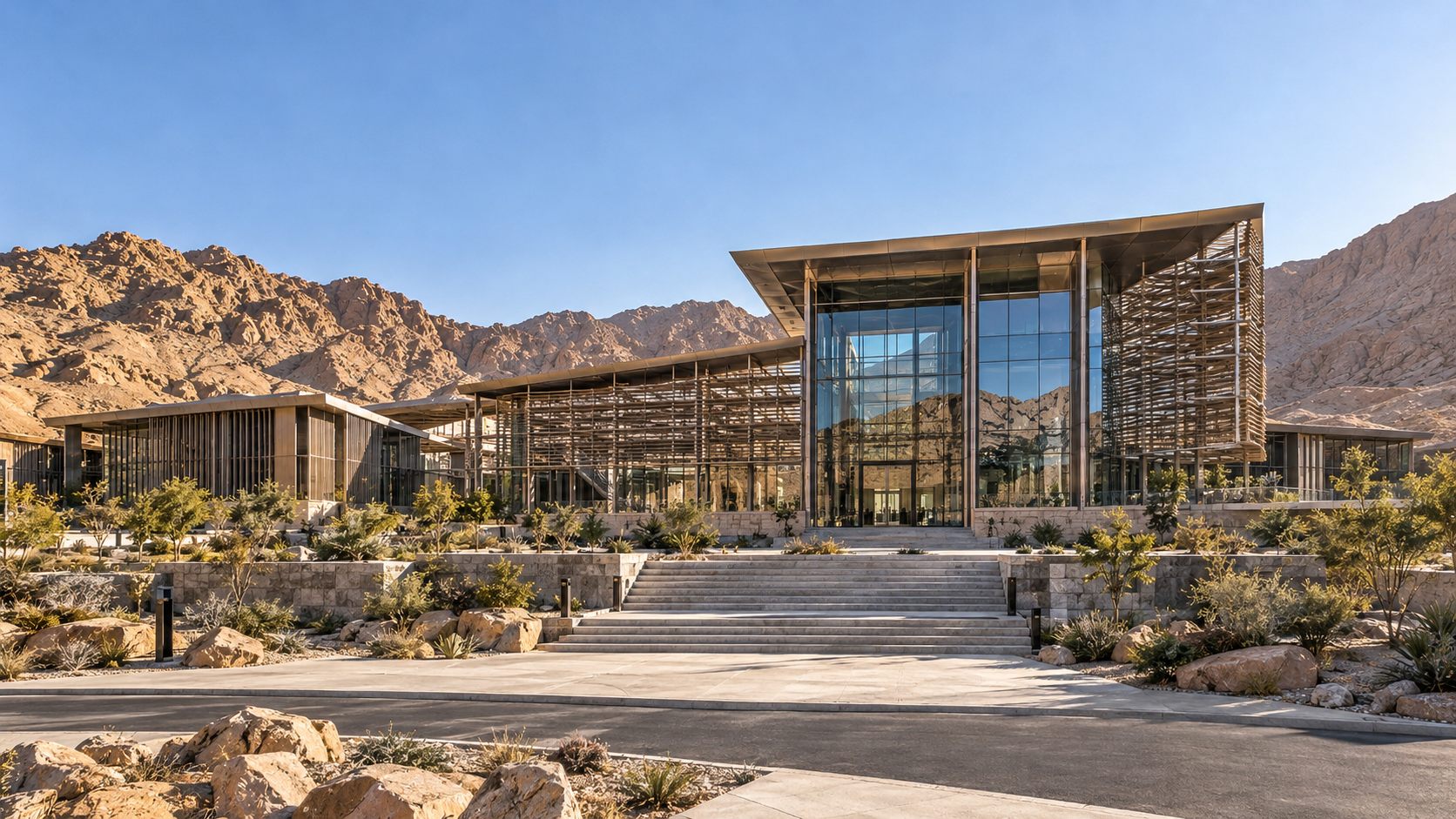
At AMTEC, a steep inclined roof projects well beyond the glazed façade and casts deep shade. Beyond the glass, a second skin of closely spaced horizontal steel louvres wraps the building. They filter direct sun, cut glare, and still let the occupants see out to the mountains. The louvres are bronze-toned, so they pick up the colour of the desert, and they throw a constantly changing pattern of light and shadow across the façade and the courtyards.
Deep overhangs, pergolas, trees, covered walkways and perforated screens all work in the same way. Traditional desert architecture has used carved screens, narrow streets and shaded courts for centuries, and for good reason.
In a hot desert the sun is the main thing a building has to manage.
Thermal mass: using the day and the night
In many deserts the temperature swings widely between day and night. Heavy materials such as stone, masonry and rammed earth absorb heat slowly during the day and release it slowly at night, which smooths the swing indoors.
This only works if the mass is used well. The walls must be shaded, so that they do not simply store the sun's heat. The building should be able to open at night and let the cool air in, and close in the day. Insulation then keeps the inside from following the outside.
At AMTEC, a stone-clad podium anchors the building in its rocky setting and adds weight at the base. Above it, lighter steel and glass structures give long spans and flexible laboratory space. Mass and lightness each go where they do the most good.
Courtyards, shade and water
A courtyard is a simple and effective piece of climate design. It makes a shaded, sheltered outdoor room that is cooler than the street, lets in daylight, and draws air through the building. At AMTEC the buildings are arranged around landscaped courtyards and linked by sheltered routes, so people can walk between them without crossing open sun.
Planting and water help, in moderation. Trees and shrubs give shade and cool the air as they transpire, but in a desert water is precious. We choose drought-tolerant planting, gravel and stone instead of lawn, and keep water features small, shaded and deliberate. The same thinking guided our concepts for Dune in Siwa and Wadi Villa in Sinai.
The details that deal with dust, wind and sand
Desert buildings need hard-working details.
- Sealed, well-fitted joints and doors keep fine dust out of laboratories and air systems.
- Filters and sensible plant locations make mechanical systems easier to protect and clean.
- Screens, windbreaks and landscape guide the wind and sand away from entrances.
- Materials are chosen to cope with strong sun, heat and abrasion, and with the occasional storm.
Do less with machines
Air conditioning will be needed in many desert buildings, and we design it carefully. But the first aim is to need less of it: shade, mass, orientation, ventilation at night and good insulation come first. Then the mechanical system can be smaller, simpler and cheaper to run, and the building stays more comfortable if the power fails.
Rooted in the place
A desert building should not look like it was dropped from somewhere else. The colours and textures of local stone, the long lines of the mountains and the clear light all belong in the design. At AMTEC the warm metal and stone echo the rock around it, and the landscape of boulders, terraces and desert planting brings the site up to the doors.
Houses can do the same on a smaller scale, as in our concepts for No.27 Private Villa in the UAE and Private Villa in Saudi Arabia, with deep shade, stone, courtyards and planting that needs little water.
Summary
- Study the sun before you draw.
- Shade the building, not just the glass.
- Use mass where it can cool the building, and keep it shaded.
- Make outdoor rooms in courtyards, with careful planting and water.
- Detail for dust, wind and heat.
- Do less with machines, and let the building do more.
AMTEC is a concept design, and the images shown on our site are visualisations (see our Disclaimers). The principles above come from how people have built in hot climates for a very long time. Every real project would need local climate data, specialist engineering and testing.
See also: AMTEC, Climate-responsive design and Operational energy.
Cite this article
Author: byJOOM. Choose a style and copy the citation.
- APA
byJOOM. (2026, October 15). Designing for the desert: shade, mass and screens. byJOOM. https://byjoom.com/journal/designing-for-the-desert/
- Harvard
byJOOM (2026) Designing for the desert: shade, mass and screens. Available at: https://byjoom.com/journal/designing-for-the-desert/ (Accessed: [date]).
- MLA
byJOOM. “Designing for the desert: shade, mass and screens.” byJOOM, 15 Oct. 2026, byjoom.com/journal/designing-for-the-desert/. Accessed [date].
- Chicago
byJOOM. “Designing for the desert: shade, mass and screens.” byJOOM, October 15, 2026. https://byjoom.com/journal/designing-for-the-desert/.