

All articles · · By byJOOM
Hotels and the sense of arrival
The first few seconds in a hotel set the tone for the whole stay. How you arrive, what you see through the door, how the light feels and who greets you tell a guest where they are and how they will be treated. Designing that moment is one of the most important jobs in hospitality architecture. This is how we think about it, with examples from Hotel H in London, Nile View Hotel in Aswan, Dune in Siwa and the towers in Alexandria.
A threshold, not just a door
An arrival should have a threshold: a change of light, floor, sound or scale that tells you you have entered somewhere different.
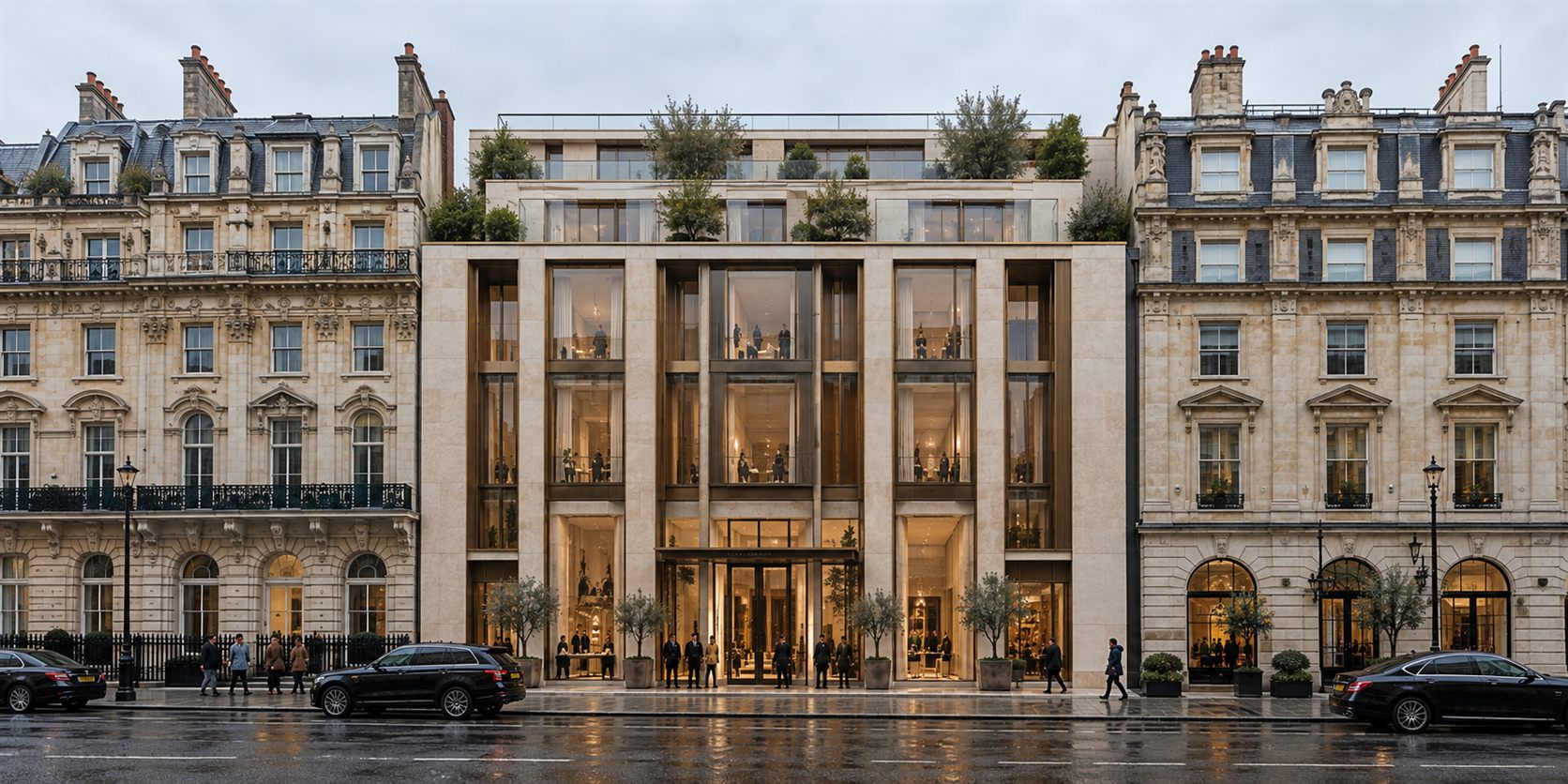
- At Hotel H, a covered entrance and warm glazing let you see the lobby from the street. Passing through, the city becomes quieter.
- At Nile View Hotel, arrival is through a curved, shaded stone court with a fountain, and a cool, timber-framed entrance with a view straight through to the river.
- At Dune, guests arrive on foot along lantern-lit boardwalks beside still water, so that slowing down is part of the arrival.
The view through
A good lobby shows you something beyond. A garden, a river, the sea, a courtyard or a staircase seen through the building gives guests a reason to walk in and a sense of what is to come. This is called a view through, and it is one of the simplest and strongest tools in hospitality design.
An arrival should have a threshold: a change of light, floor, sound or scale that tells you you have entered somewhere different.
Light, sound and scent
The senses make a place memorable. Light that is warm and low, soft acoustics, natural materials and the smell of a place, such as citrus, cedar or the sea, are all part of the arrival. We think about each of them.
Clear and unhurried
Guests are often tired, and want to be looked after. The route from the door to reception should be obvious, with space to put down bags and somewhere comfortable to sit. A good reception is easy to find and not hidden behind a long hall.
Separate the back from the front
A hotel is also a workplace. Deliveries, kitchens, laundry and staff routes need their own entrances and corridors, away from guests. Good hotels are smooth at the front because they are well organised at the back.
Local character
The best hotels belong to their place. Local stone, timber, crafts, plants and views make a guest feel they are somewhere and not anywhere. See also Choosing materials.
A place for the city, too
A hotel lobby, restaurant or garden can be part of its neighbourhood, open to people who are not staying. At Hotel H a courtyard garden brings green into the heart of the city, and the restaurants and terraces at our waterfront towers and hotels are designed to be used by everyone.
Leaving well
The last impression counts as much as the first. A calm, unrushed departure, with the same warmth as the arrival, brings people back.
All of these are concept designs, and the images on our site are visualisations (see our Disclaimers).
See also: Hospitality and resorts.
Cite this article
Author: byJOOM. Choose a style and copy the citation.
- APA
byJOOM. (2026, October 15). Hotels and the sense of arrival. byJOOM. https://byjoom.com/journal/hotels-and-the-sense-of-arrival/
- Harvard
byJOOM (2026) Hotels and the sense of arrival. Available at: https://byjoom.com/journal/hotels-and-the-sense-of-arrival/ (Accessed: [date]).
- MLA
byJOOM. “Hotels and the sense of arrival.” byJOOM, 15 Oct. 2026, byjoom.com/journal/hotels-and-the-sense-of-arrival/. Accessed [date].
- Chicago
byJOOM. “Hotels and the sense of arrival.” byJOOM, October 15, 2026. https://byjoom.com/journal/hotels-and-the-sense-of-arrival/.