

All articles · · By byJOOM
The souk and the mall
People have shopped in the open air and under cover for as long as there have been towns. The souk, with its shaded lanes, courtyards and workshops, and the modern mall, with its air conditioning and anchor stores, are two answers to the same question: how do you make a place where people want to spend time buying and selling? We think the best answer today borrows from both. Our concepts for Souk Al Noor in Riyadh and Harbour Mall in Dubai show two ways.
What the souk teaches
A traditional souk is comfortable without machines. It has narrow, shaded lanes, courtyards, trees and water, goods spread along a walkable route, and a lively mix of trades. It is social, local and human in scale.
What the mall offers
A modern mall gathers many shops, restaurants and entertainment under one roof, protected from heat and weather. It is easy, secure and efficient, and a mall can be a destination for a family's day.
A traditional souk is comfortable without machines.
Souk Al Noor: shade as architecture
In Riyadh, our concept for Souk Al Noor takes the souk idea and gives it a contemporary form. Slender, tree-like steel columns carry perforated metal canopies that cast patterned shade over pale stone lanes. Olive trees and planters sit in the courtyards, with seating and soft light. The canopies cut direct sun while the open sky and moving air keep the place fresh. Shops, studios and restaurants face the lanes, and the central court is a place to meet. See also Courtyards and Designing for the desert.
Harbour Mall: stone and water
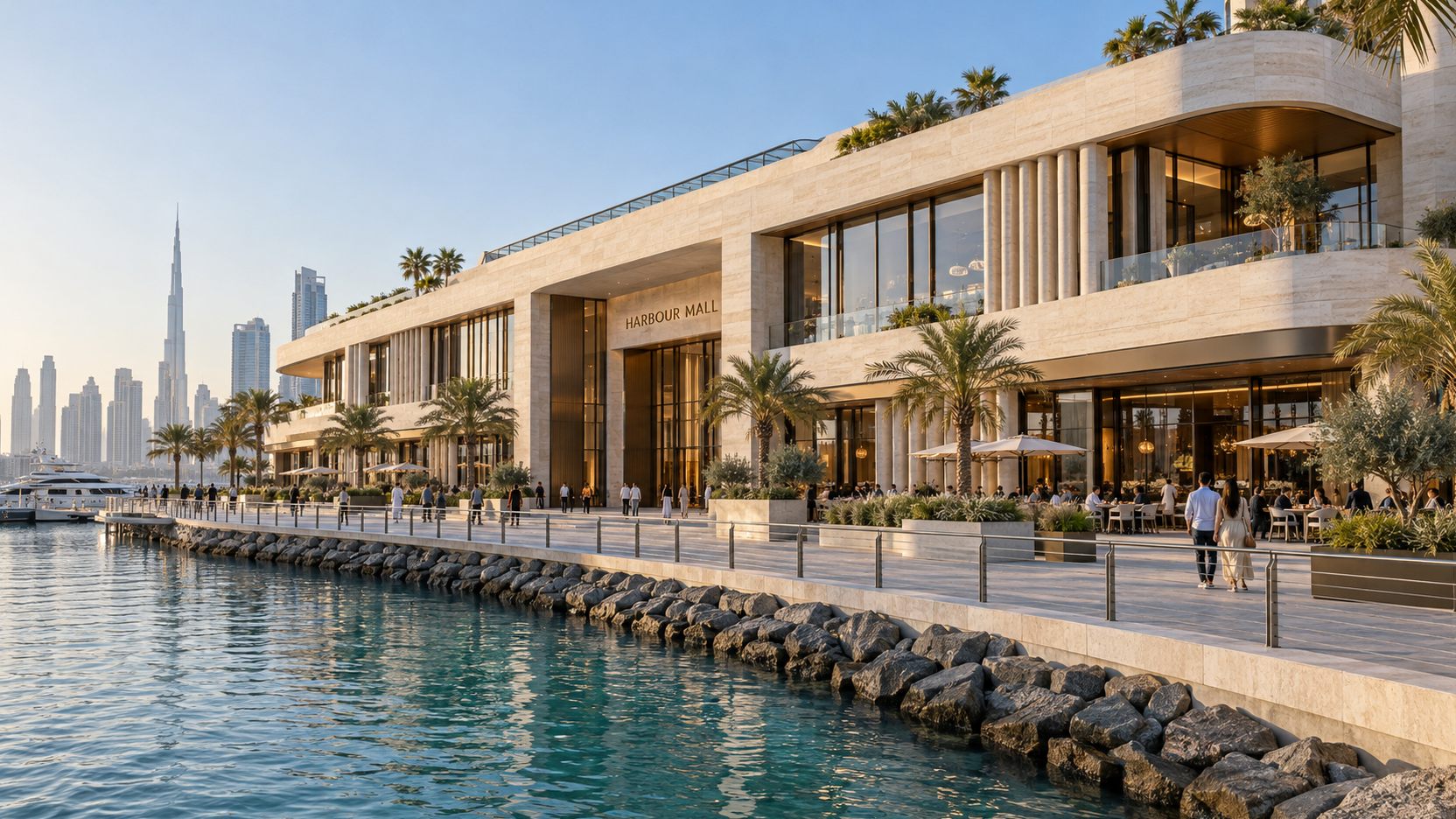
In Dubai, our concept for Harbour Mall sits on the water. Long terraces of pale travertine, with fluted columns and bronze-framed glass, step along a public promenade with palms and olive trees. Inside, galleries open onto a tall, skylit atrium with a view of the harbour. Restaurants and cafés face the water, and the building also includes a cinema and play areas for families. The mall reaches out to the shore, so that visitors and passers-by share the same waterfront.
What we take from both
- Shade and comfort. Whether a canopy or a roof, make the place comfortable first.
- A route, not a box. A walk with variety, views and places to stop makes shopping a pleasure.
- Courtyards and atria. A heart that gives a place identity and helps people find their way.
- Planting and water. Trees and water make a place feel alive, and cool it.
- Food and meeting. Restaurants and cafés keep people there and make the place social.
- Local character. Stone, crafts, patterns and plants that belong to the region.
- The edge. A shopping place should be good to walk past, as well as to walk into.
Shops, signs and brands
The images of these concepts are visualisations, and any shop names or signs in them are for illustration only. We have chosen images that avoid third-party brand names, and the concepts are not connected with any retailer. See our Disclaimers.
The future of shopping
As more shopping moves online, places to shop have to offer something a screen cannot: a pleasant place to be, good food, craft, culture, company and the pleasure of a well-made public room.
See also: Retail and leisure.
Cite this article
Author: byJOOM. Choose a style and copy the citation.
- APA
byJOOM. (2026, October 15). The souk and the mall. byJOOM. https://byjoom.com/journal/the-souk-and-the-mall/
- Harvard
byJOOM (2026) The souk and the mall. Available at: https://byjoom.com/journal/the-souk-and-the-mall/ (Accessed: [date]).
- MLA
byJOOM. “The souk and the mall.” byJOOM, 15 Oct. 2026, byjoom.com/journal/the-souk-and-the-mall/. Accessed [date].
- Chicago
byJOOM. “The souk and the mall.” byJOOM, October 15, 2026. https://byjoom.com/journal/the-souk-and-the-mall/.