

All articles · · By byJOOM
From sketch to site: how an idea survives
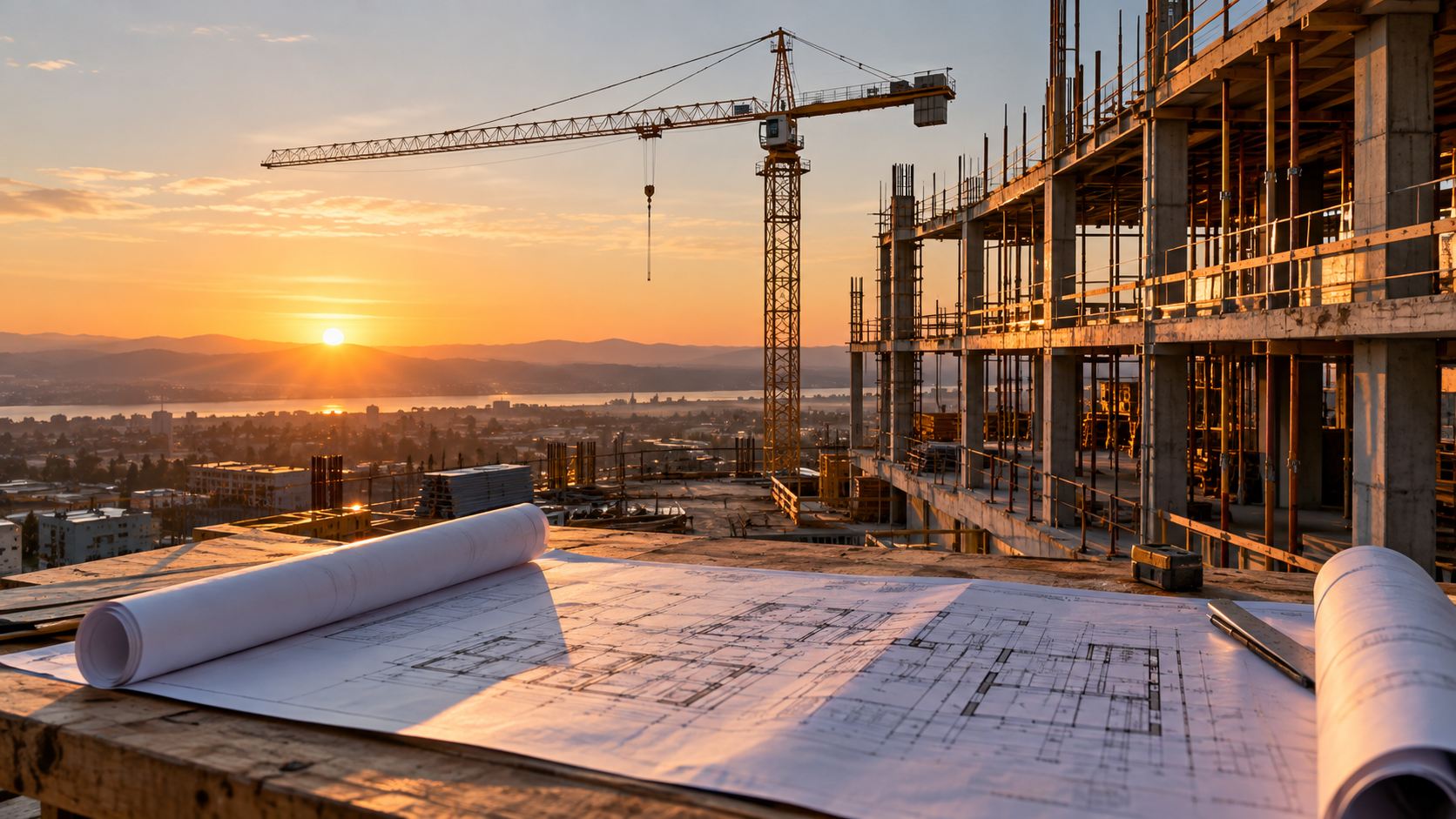
Every building begins as a sketch: a few lines on paper, a model on a table, an idea about how people might live, work or gather. Between that moment and the day the building opens, the idea has to survive many things. It must be drawn, priced, approved, built and handed over, by many people, under pressure of time and money. Some of it is always lost. The aim is to lose as little of what matters as possible. This article follows an idea from the sketch to the site, and explains how we try to keep it alive. For the sequence of stages, see also From brief to building.
The sketch: what the idea is
A good sketch is not a picture. It is a decision about what matters most: a shaded courtyard, a long view, a calm front, a roof that floats. Before we move on, we write it down in plain words. If the team can't say in a sentence what the building is about, the idea is not ready to be built.
Drawings: making the idea precise
Drawings turn the idea into something that can be checked and built.
- Concept drawings set the layout, form and character.
- Developed design brings in the structure, services, façade and materials, and tests that the idea works with them. This is where many ideas are quietly spoiled: a beam is deeper than expected, a duct has nowhere to go, a window must shrink. We solve these early, with the engineers in the room.
- Technical drawings and specifications describe every junction, material, finish and fixing. A good specification says what is wanted and how good it must be, in words that a builder cannot misread.
Coordination is the quiet work in this stage. Architectural, structural, mechanical, electrical and landscape drawings must all agree, and a coordinated model or drawings set helps find clashes on screen, not on site.
It is a decision about what matters most: a shaded courtyard, a long view, a calm front, a roof that floats.
Approvals: the idea meets the rules
Planning, building, fire, health and utility authorities must review and approve. They are essential to safety and to the city. They also change things. We try to understand the rules at the start, so that requirements shape the design from the first sketch and are not added afterwards as compromises.
Tender: the idea meets the price
Builders price the drawings. If the price is above the budget, something must change. The danger here is cuts that remove the very thing that made the building special.
- Value, not just cost. We look at what a feature does for the building, and what it will cost to run and maintain over time.
- Protect the essentials. We agree early which parts of the idea are essential, such as the façade, the key materials and the main spaces, and which can change.
- Clear alternatives. If a builder proposes a substitute, we compare it carefully with what was specified, for appearance, durability, maintenance and carbon, before we agree to it.
A well-written specification and a drawing set that leaves little room for guessing make the tender a fair comparison and protect the idea.
Construction: the idea meets the site
On site the building meets weather, ground, materials, tools and people. Things will differ from the drawings. The question is how well they are handled.
- Samples and mock-ups. Before a whole façade is built, we ask for a sample or a full-size section of it. We can see the colour, texture, joints and details before they are repeated a thousand times.
- Site visits and questions. Builders will have questions, and answers should come quickly and from the people who understand the design.
- Checking the work. We look at what is built, in the order it is built, so that problems are found while they are still easy to fix.
- Change control. Every change is written down, with its effect on cost, time and quality, and agreed before it happens.
- Respect for the craft. The people who build the work make it. We speak to them early and clearly, and listen to what they know.
Handover: the idea meets the people
When the building is finished, it is tested, inspected and handed to its owners. We help them learn how to use and look after it, and we go back after the first year to see how it is working. What we learn there goes into the next sketch.
Why ideas get lost, and how to keep them
Most of the time, a good idea is not lost in one big decision. It is lost in many small ones, each of which seemed reasonable at the time. A detail simplified, a material swapped, a view blocked by a duct. We try to prevent this in four ways.
- Say what matters. Write down the essentials at the start, and keep them in front of the team.
- Keep the team together. The people who made the design should stay involved through the tender and the construction.
- Decide on paper. Put every important choice in drawings and specifications, so that the idea does not depend on memory.
- See it before it is built. Models, samples and mock-ups let everyone check, not hope.
In short
A building is only as good as the idea that survives to the day it opens. Drawings give the idea precision, approvals give it permission, tender gives it a price and construction gives it form. Our job is to be there for all of it.
See also: Strategic consultancy and delivery, Construction delivery and contract administration and What an architect does, and what an engineer does.
Cite this article
Author: byJOOM. Choose a style and copy the citation.
- APA
byJOOM. (2026, October 15). From sketch to site: how an idea survives. byJOOM. https://byjoom.com/journal/from-sketch-to-site/
- Harvard
byJOOM (2026) From sketch to site: how an idea survives. Available at: https://byjoom.com/journal/from-sketch-to-site/ (Accessed: [date]).
- MLA
byJOOM. “From sketch to site: how an idea survives.” byJOOM, 15 Oct. 2026, byjoom.com/journal/from-sketch-to-site/. Accessed [date].
- Chicago
byJOOM. “From sketch to site: how an idea survives.” byJOOM, October 15, 2026. https://byjoom.com/journal/from-sketch-to-site/.