

All articles · · By byJOOM
Rain, brick and timber
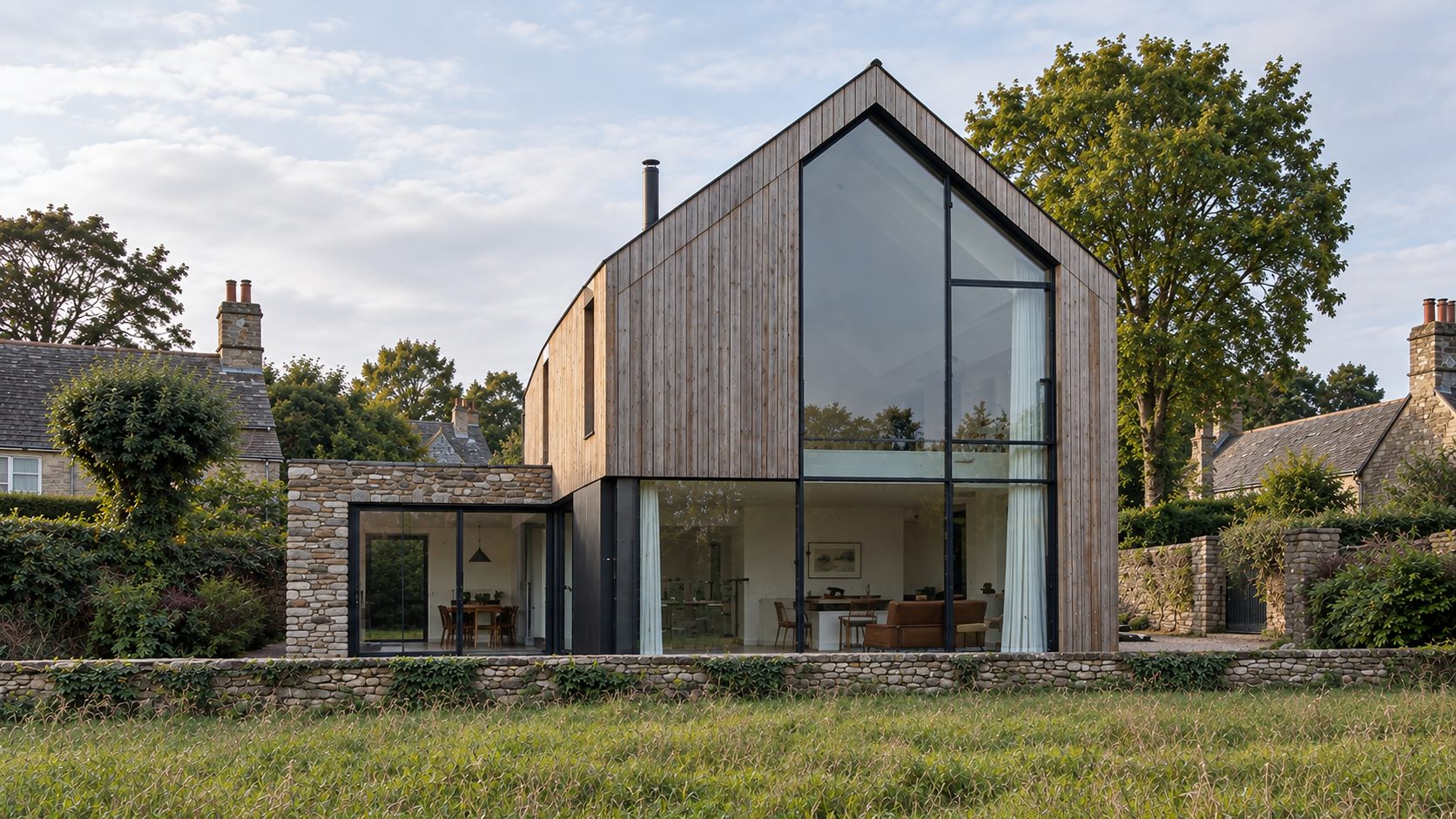
Walk down a British street in the rain and you will see why so many buildings there are made of brick, slate and timber. They cope with water, they weather well and they look better wet. When we design in wet, cool climates, we start from the same lessons, using our concepts for The Orchard School, The Barn, The Wellbeing Clinic and Village Home as examples.
Keep the water out, and let it go
In a wet climate, water is the main enemy of a building. The aim is to keep it out and to let it run away.
- Generous roofs and eaves. Pitched roofs in zinc, slate or tile shed water quickly. Deep eaves protect the walls below.
- Good junctions. Most leaks happen where materials meet. We detail every junction carefully, with gutters and downpipes that are visible and easy to clean.
- Drained walls. Brick walls are built with a cavity and drainage, so water that gets in has a way out.
- Raised bases. Walls start above ground level, with a plinth of stone or brick that does not rot or stain.
Brick: a patient material
Brick is made of fired clay and it lasts for centuries. It is strong, it does not need painting, it ages gracefully, and it is repaired by replacing a single brick. Its colour and texture vary, which gives a wall depth. At The Wellbeing Clinic, red brick matches the terraced streets nearby, and at The Orchard School warm brick and timber give a village scale.
In a wet climate, water is the main enemy of a building.
Timber: warm and renewable
Timber stores carbon, feels warm to the touch and can be shaped easily. In the rain it needs care.
- We choose timber that can weather and species that suit the exposure.
- We detail it so that water drains away and end grain is protected.
- Inside, exposed timber structure, as in the classrooms at The Orchard School, brings warmth and needs little finishing.
- Over time, outdoor timber turns silver-grey. We design for that, instead of fighting it. See also Choosing materials.
Light is precious
Grey days mean daylight is precious. We use tall windows, rooflights and atria to bring it deep into the building, and pale internal finishes to carry it further. At The Wellbeing Clinic, a daylit atrium brightens the heart of the building on the dullest day.
Making gardens that work in the wet
A wet climate is good for planting. We use trees, shrubs and grasses that thrive in it, and we design rain gardens and permeable surfaces so that water soaks into the ground and does not flood the street. At The Orchard School, an orchard and meadow planting turn rainwater into part of the landscape.
Cold as well as wet
Cold needs insulation, airtightness and careful ventilation. We insulate generously, avoid cold bridges and use efficient heating. A well-insulated building with good daylight and a warm interior feels welcoming in winter.
A building that looks right wet
The best buildings for this climate look good on a wet day. Brick darkens, slate shines, timber glows and puddles reflect lit windows. We choose materials with this in mind.
All of these are concept designs, and the images on our site are visualisations (see our Disclaimers). Real projects need local climate data, specialist engineering and approvals.
Cite this article
Author: byJOOM. Choose a style and copy the citation.
- APA
byJOOM. (2026, October 15). Rain, brick and timber. byJOOM. https://byjoom.com/journal/rain-brick-and-timber/
- Harvard
byJOOM (2026) Rain, brick and timber. Available at: https://byjoom.com/journal/rain-brick-and-timber/ (Accessed: [date]).
- MLA
byJOOM. “Rain, brick and timber.” byJOOM, 15 Oct. 2026, byjoom.com/journal/rain-brick-and-timber/. Accessed [date].
- Chicago
byJOOM. “Rain, brick and timber.” byJOOM, October 15, 2026. https://byjoom.com/journal/rain-brick-and-timber/.