

All articles · · By byJOOM
Building on the sea
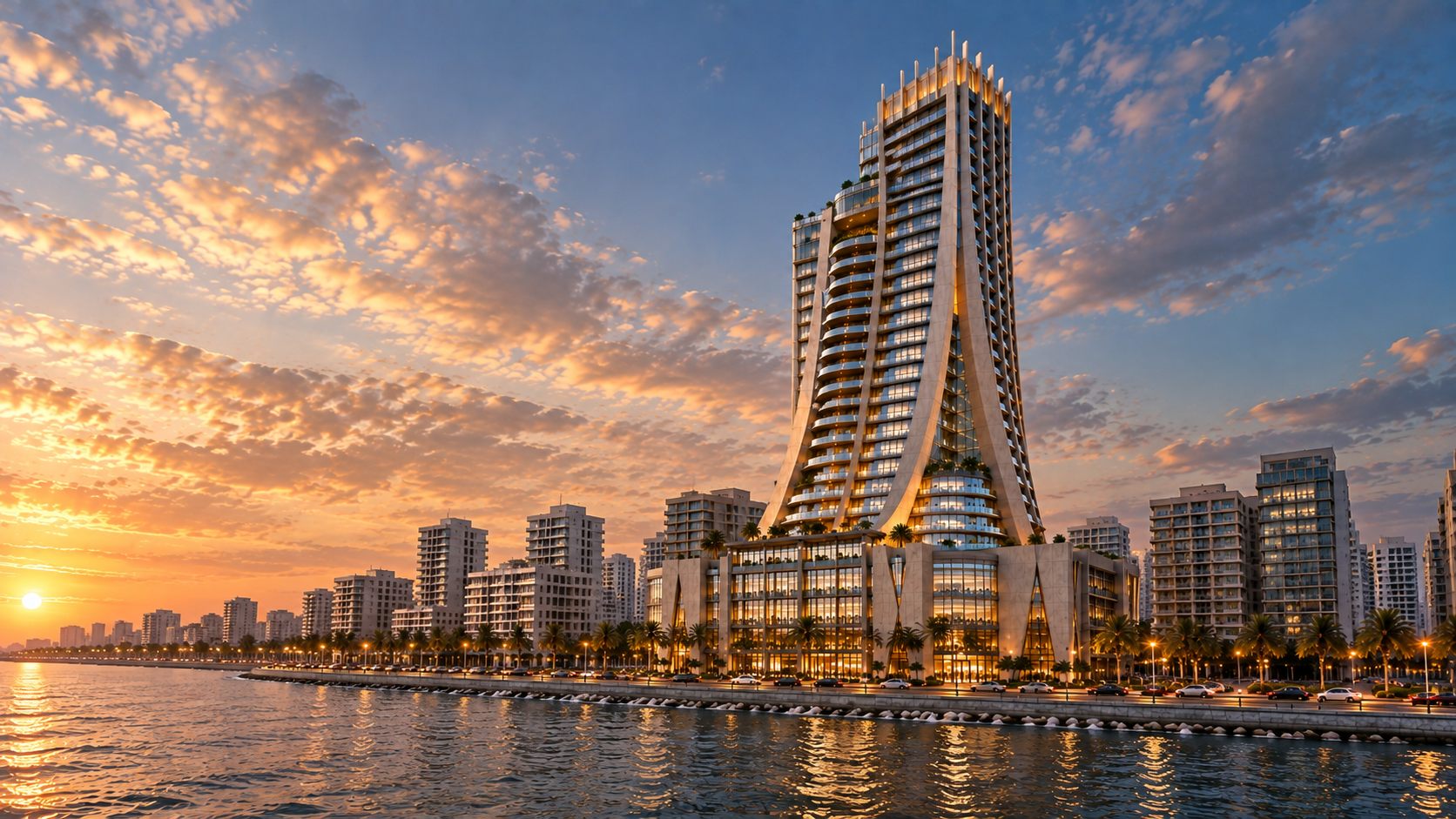
A building beside the sea gets the best view and the hardest conditions. Salt, humidity, wind, strong sun and sometimes storms all work on it every day. Here is how we think about designing for the Alexandria corniche and other coasts, with our concepts for Alexandria Tower, The Beacon and the Museum of the Sea as examples.
Salt is the first enemy
Salt in the air attacks metal, concrete reinforcement and finishes. That shapes our choices.
- Metals. We favour corrosion-resistant metals and good protective coatings, and we avoid details where salt water can sit.
- Concrete. We design for generous cover to reinforcement and specify mixes suited to marine air, with specialist advice.
- Stone and masonry. Dense limestone and well-detailed masonry cope well with coastal weather. They also suit the colours of the sea front.
- Maintenance. We make surfaces easy to reach and wash, because salt is removed by water.
Wind and storms
Tall buildings by the sea are exposed. We shape towers so that wind flows around them, we design façades and balconies to resist wind loads, and we think about what happens to people at ground level, where tall forms can create gusts. At The Beacon and Alexandria Tower, a slender, softly curved profile and planted terraces help soften the wind.
Salt in the air attacks metal, concrete reinforcement and finishes.
Shade and glare
The sea throws light back at a building. Glass needs shade, and rooms with a sea view often need protection from low sun. Deep terraces, planted balconies, fins and screens give shade and keep the view. See also Designing for the desert, as much of the same thinking applies.
Give the edge back
A sea front is a public place. A good building lets people reach the water. In our concepts, a wide promenade, planted terraces, shops and cafés at street level and an open, glazed lobby make the building part of the shore walk and not a wall against it. The Museum of the Sea steps down to the harbour, so that visitors can see the water from the atrium.
Rising water
Sea level and storm surge are real risks on many coasts. We study flood levels early, raise important rooms and plant, and keep the lowest floors for uses that can cope with water. Planted shorelines, rocks and wide promenades can absorb waves better than a hard wall. See also Resilience and adaptation.
A building that belongs to its water
A good coastal building looks as though it could only be where it is. Its colours come from sand and stone, its form from the wind and the horizon, and its terraces from the way people use the shore.
Our coastal projects are concept designs, and the images on our site are visualisations (see our Disclaimers). Any real project needs marine engineering, wind and flood studies and local approvals.
Cite this article
Author: byJOOM. Choose a style and copy the citation.
- APA
byJOOM. (2026, October 15). Building on the sea. byJOOM. https://byjoom.com/journal/building-on-the-sea/
- Harvard
byJOOM (2026) Building on the sea. Available at: https://byjoom.com/journal/building-on-the-sea/ (Accessed: [date]).
- MLA
byJOOM. “Building on the sea.” byJOOM, 15 Oct. 2026, byjoom.com/journal/building-on-the-sea/. Accessed [date].
- Chicago
byJOOM. “Building on the sea.” byJOOM, October 15, 2026. https://byjoom.com/journal/building-on-the-sea/.