

All articles · · By byJOOM
The mosque as a public building
A mosque is a place of prayer, and it is also one of a community's most important public buildings. People gather there every day, and many times a day, from every part of society. Designing one is a privilege and a responsibility. This article sets out how we think about it, with our concepts for Masjid Al Noor in Amman and Al Salam Mosque in Dubai.
Respect first
Before anything else, a mosque is designed with respect for the faith and its traditions. The direction of prayer, the arrangement of the prayer hall, space for ablution, separate and equal provision for men and women, and the role of the minaret and the mihrab all follow established practice. We work with the client, scholars and the community so that the design is right in its use as well as in its form.
Light as the main decoration
Many of the finest mosques use light as their main ornament, and we take that lead.
- At Al Salam Mosque, a simple stone volume has a tall carved bronze screen on its entrance front. In the prayer hall, tall screens turn strong sun into soft, moving patterns on the floor and walls.
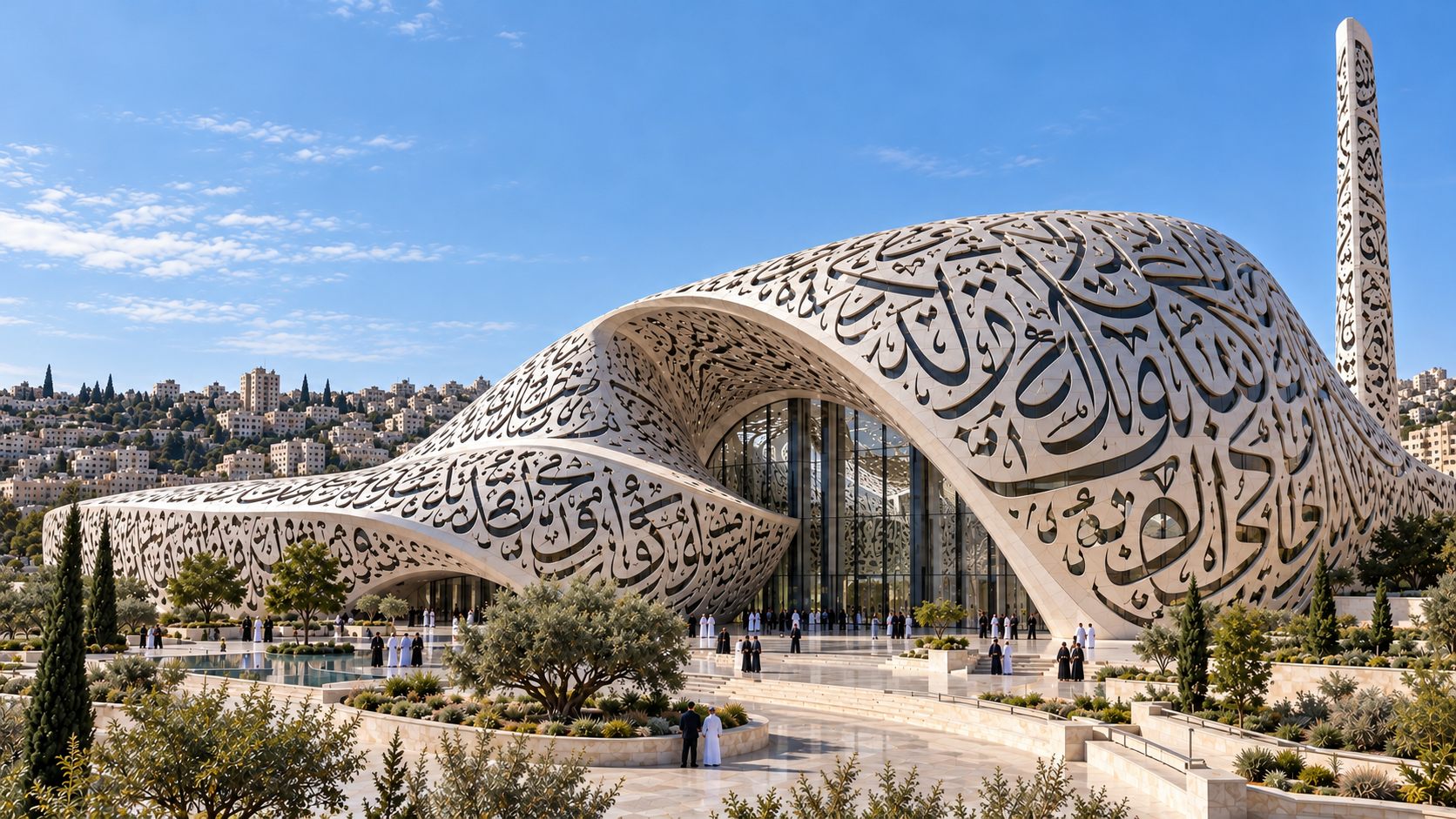
- At Masjid Al Noor, a single sweeping shell of pale stone is cut with large calligraphic openings. Light enters through the writing, so the words themselves become the decoration and the source of light.
In both, the building is calm and the light does the work.
Before anything else, a mosque is designed with respect for the faith and its traditions.
Calligraphy, pattern and geometry
Islamic art is rich in calligraphy, geometry and pattern. We use them with care, as part of the structure and the screens, so that they carry meaning and are not applied as surface decoration. The patterns respond to the climate by filtering sun and glare. See also Light.
A public building as well as a prayer hall
A mosque serves many needs beyond prayer: classrooms, a library, a hall for talks and events, a place for the community to meet and to help those in need. At Al Salam Mosque, classrooms, a multipurpose hall and a courtyard of olive and date trees sit around the prayer hall. See also Courtyards. The mosque becomes the heart of the neighbourhood.
Welcoming to everyone
A mosque should feel open to its community. A generous entrance court, shaded approaches, water and planting, clear routes and level access for the elderly and disabled help people to arrive and to feel welcome. Visitors from other faiths should feel invited to learn.
Climate, materials and craft
We choose materials that suit the place and age well: local stone, bronze, timber and glass. At Masjid Al Noor the stone is carved with fine detail, and at Al Salam Mosque the metalwork and screens are finely crafted. A mosque is built to last for generations, so craft matters. See also Choosing materials.
Quiet
The prayer hall should be a place of stillness. Acoustics, daylight and the scale of the room are designed so that voices carry clearly, sound is not harsh, and the space is peaceful.
About these designs
Masjid Al Noor and Al Salam Mosque are concept designs, and the images on our site are visualisations (see our Disclaimers). Any real mosque would be developed with the client, religious authorities, the local community, specialist engineers and the relevant approvals.
Cite this article
Author: byJOOM. Choose a style and copy the citation.
- APA
byJOOM. (2026, October 15). The mosque as a public building. byJOOM. https://byjoom.com/journal/the-mosque-as-a-public-building/
- Harvard
byJOOM (2026) The mosque as a public building. Available at: https://byjoom.com/journal/the-mosque-as-a-public-building/ (Accessed: [date]).
- MLA
byJOOM. “The mosque as a public building.” byJOOM, 15 Oct. 2026, byjoom.com/journal/the-mosque-as-a-public-building/. Accessed [date].
- Chicago
byJOOM. “The mosque as a public building.” byJOOM, October 15, 2026. https://byjoom.com/journal/the-mosque-as-a-public-building/.