

All articles · · By byJOOM
Local stone, local craft
The nearest quarry and the nearest builder are often the best partners a building can have. Local stone looks as if it belongs, because it comes from the same ground. Local craft knows the climate. This article explains why we favour them where we can, using concepts such as Wadi Villa, Private Home in Amman, Nile View Hotel and The Barn.
It belongs
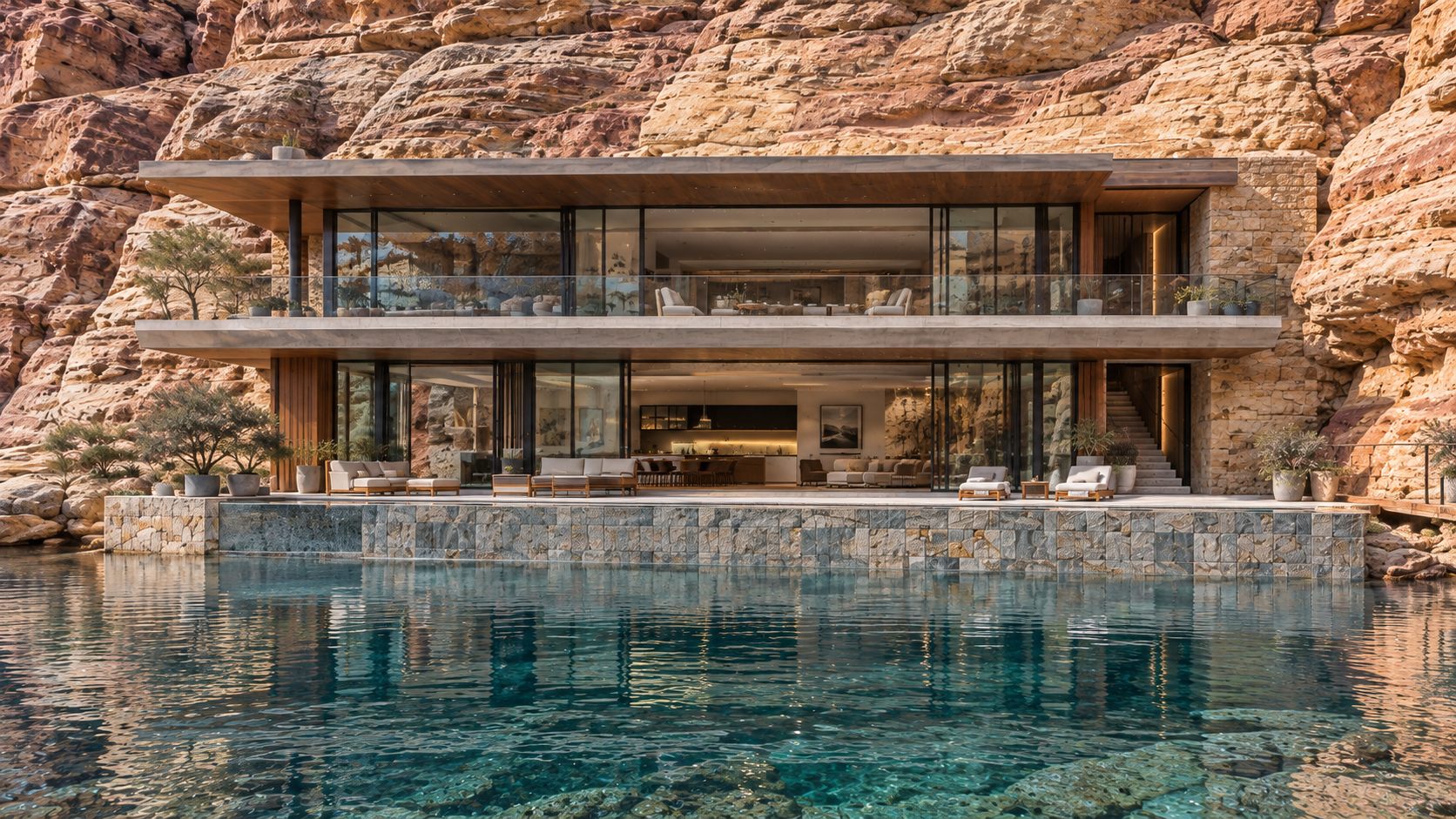
Local stone matches the colour of the land around it. A house of sandstone in a sandstone valley, limestone on a limestone hill, or granite beside the Nile does not need to be explained. At Wadi Villa, stone and glass sit in the colours of the canyon wall. At Private Home in Amman, limestone terraces follow the hill. At The Barn, dry stone and weathered timber join the village. See also Choosing materials.
It has a lower footprint
Stone, brick and timber that travel a short way avoid the carbon and cost of long transport. Local materials also use the energy of the region's own industry. This is not always the lowest-carbon choice, since quarrying and processing have impacts, but it is often a sensible one. See also Embodied carbon in plain language.
Local stone matches the colour of the land around it.
It suits the climate
Over generations, local builders learn what works: how thick a wall should be, how a roof should drain, how deep a shade should go. Traditional techniques, such as thick stone walls, courtyards, shaded lanes and screens, are answers to the local climate. See also Designing for the desert and Courtyards.
It supports people
Using local craftspeople keeps skills alive and money in the community. A project that employs local stonemasons, carpenters and metalworkers leaves more than a building behind. We try to find, listen to and learn from the people who know the material best.
It ages well
Materials that belong to a place often weather as the place does. Stone develops colour, brick softens, timber turns silver. Because the material is familiar to local builders, it can be repaired in the way it was made.
What we ask
- Where does the material come from, and how far does it travel?
- How is it quarried, grown or made, and what is the impact?
- Is there a local workforce with the right skills?
- Is the supply reliable and of consistent quality?
- Can it be repaired and reused?
Honest limits
Local is not always best. A local stone may be too soft, too variable or too scarce for a given job. A local craft may have died out. Safety, performance and cost may need other materials or imported products. We weigh these honestly, and where we use a non-local material we aim to do so for a good reason, with proper certification and testing.
Respect and credit
Craft deserves credit. The people who cut, lay and fix the material make the building. We try to learn from them and to design details that suit their skills.
All of the projects named here are concept designs, and the images on our site are visualisations (see our Disclaimers).
Cite this article
Author: byJOOM. Choose a style and copy the citation.
- APA
byJOOM. (2026, October 15). Local stone, local craft. byJOOM. https://byjoom.com/journal/local-stone-local-craft/
- Harvard
byJOOM (2026) Local stone, local craft. Available at: https://byjoom.com/journal/local-stone-local-craft/ (Accessed: [date]).
- MLA
byJOOM. “Local stone, local craft.” byJOOM, 15 Oct. 2026, byjoom.com/journal/local-stone-local-craft/. Accessed [date].
- Chicago
byJOOM. “Local stone, local craft.” byJOOM, October 15, 2026. https://byjoom.com/journal/local-stone-local-craft/.