

All articles · · By byJOOM
Embodied carbon in plain language
When people talk about a green building, they usually mean one that uses little energy once it is open. That matters. But there is another kind of carbon, which is already spent before the building opens: the carbon released in making the materials, transporting them, building and, eventually, taking the building apart. That is called embodied carbon. This article explains it in plain language, and the main things that reduce it. See also Embodied carbon.
Two kinds of carbon
- Operational carbon comes from running the building: heating, cooling, lighting and equipment, year after year.
- Embodied carbon comes from making the building: extracting and manufacturing materials, moving them to the site, constructing, maintaining and eventually demolishing or reusing the building.
As buildings become more energy-efficient, embodied carbon becomes a larger share of a building's total impact, and it is spent all at once, at the start. That is why it is important to think about it early.
Where it comes from
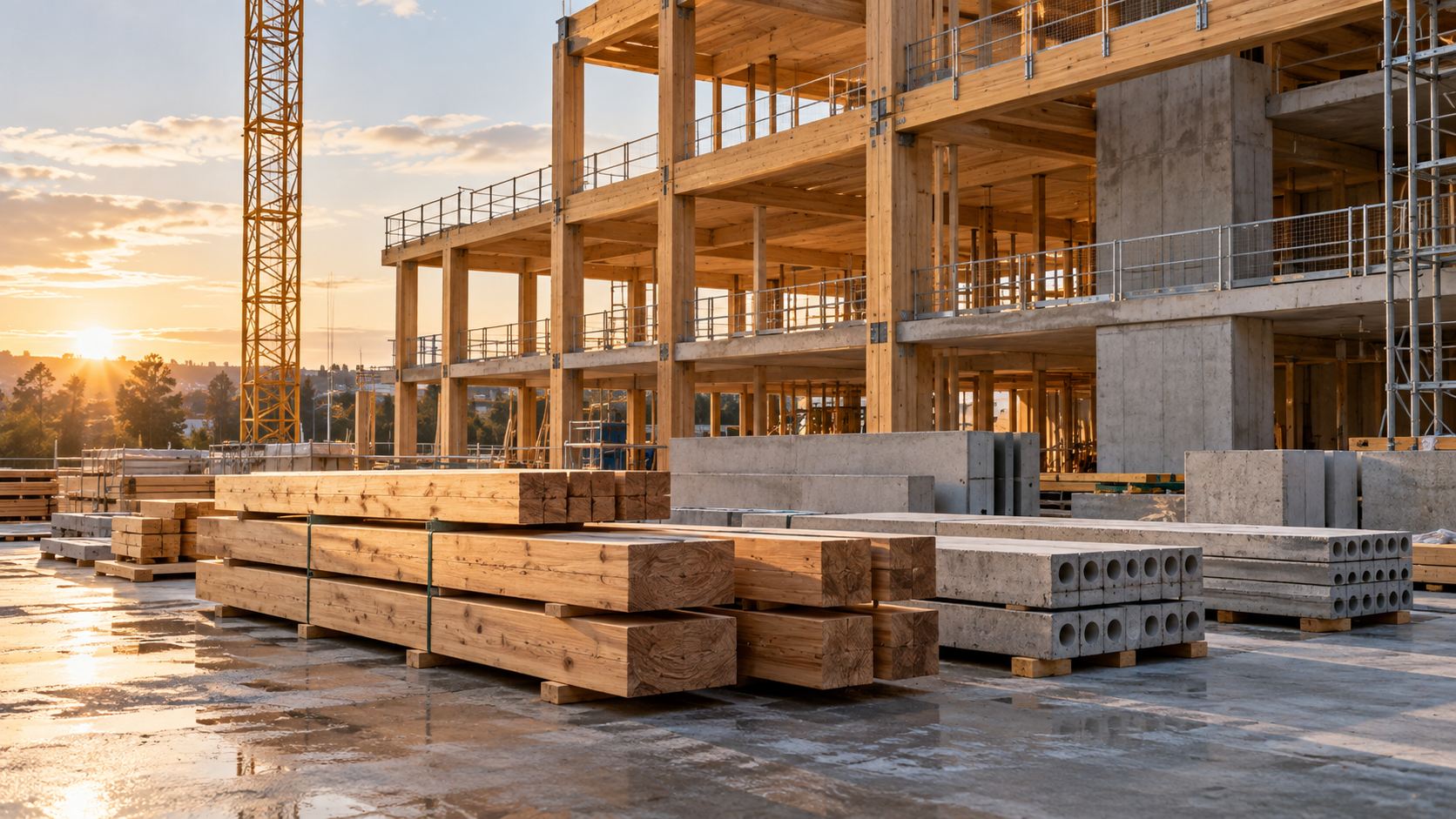
Some materials take a lot of energy to make. Cement and steel are among the big ones, because making them needs very high temperatures. Aluminium and some plastics are also energy-intensive. Others, like timber, stone, earth and brick, can have a lower footprint, depending on how they are sourced and made, though none is free of impact. Transport matters too: a heavy material carried a long way adds carbon.
As buildings become more energy-efficient, embodied carbon becomes a larger share of a building's total impact, and it is spent all at once, at the start.
Five things that reduce it
- Reuse what exists. The lowest-carbon building is the one you do not have to build. Refurbishing, extending and adapting an existing building avoids most of the embodied carbon of a new one. See also Reuse before new build.
- Use less. A simple, efficient structure with sensible spans, a compact form and no unnecessary material costs less carbon, and usually less money. Every element should earn its place.
- Choose lower-carbon materials. Where the project allows, we use timber from responsible sources, lower-carbon concrete mixes, steel with high recycled content, local stone and earth-based materials. See also Choosing materials.
- Build to last. A building that lasts a hundred years has a much lower yearly carbon footprint than one replaced after thirty. Durable materials, good details and easy repair help. See also Detail: why edges matter.
- Design for the end. If a building can be taken apart, its materials can be used again. Simple, demountable connections, standard sizes and a record of what is in the building make that possible. See also Circular design.
Measure and compare
We compare options early, when changes are cheap. Specialists can estimate the embodied carbon of different structures and materials, so that decisions are made with some evidence and not with guesses. Methods and data differ, and they change, so we are careful about how we use figures.
It is a balance
Lower carbon is not the only goal. A building must be safe, durable, comfortable, healthy, beautiful and affordable. A very low-carbon material that fails early is not a good choice. We weigh the benefits and make honest trade-offs, and where the evidence is uncertain we say so.
In short
- Carbon is spent in making a building, not only in running it.
- The best saving is to reuse what exists.
- Use less, use lower-carbon materials and build to last.
- Design so the building can be reused or taken apart.
- Compare early, and be honest about the trade-offs.
Cite this article
Author: byJOOM. Choose a style and copy the citation.
- APA
byJOOM. (2026, October 15). Embodied carbon in plain language. byJOOM. https://byjoom.com/journal/embodied-carbon-in-plain-language/
- Harvard
byJOOM (2026) Embodied carbon in plain language. Available at: https://byjoom.com/journal/embodied-carbon-in-plain-language/ (Accessed: [date]).
- MLA
byJOOM. “Embodied carbon in plain language.” byJOOM, 15 Oct. 2026, byjoom.com/journal/embodied-carbon-in-plain-language/. Accessed [date].
- Chicago
byJOOM. “Embodied carbon in plain language.” byJOOM, October 15, 2026. https://byjoom.com/journal/embodied-carbon-in-plain-language/.