

All articles · · By byJOOM
Reuse before new build
The most sustainable building is often the one that is already standing. Before we draw anything new, we ask whether an existing building could be kept, repaired and given a new life. This article explains why reuse comes first and how it works, with a link to our concept for Müdrik School of Architecture in Istanbul, which is built around a retained historic building.
Why reuse
- Carbon. A new building spends a great deal of carbon in making its materials and constructing. Reusing a structure saves most of it. See also Embodied carbon in plain language.
- Character. Old buildings have materials, proportions and a patina that new ones take decades to earn. They give a place identity and memory.
- Community. People are attached to familiar buildings. Reusing them keeps the story of the place going.
- Cost and time. Reuse is sometimes cheaper and quicker, though not always. Hidden conditions can be expensive, so surveys matter.
- Waste. Demolition makes a lot of waste. Reuse keeps materials in use.
What can be reused
- The whole building, with a new use: a warehouse becomes studios, a mill becomes homes, a customs house becomes a hotel.
- The structure, with a new skin and interior: the frame is kept and everything else is renewed.
- Parts, such as a façade, a hall or a tower, kept and joined to a new building.
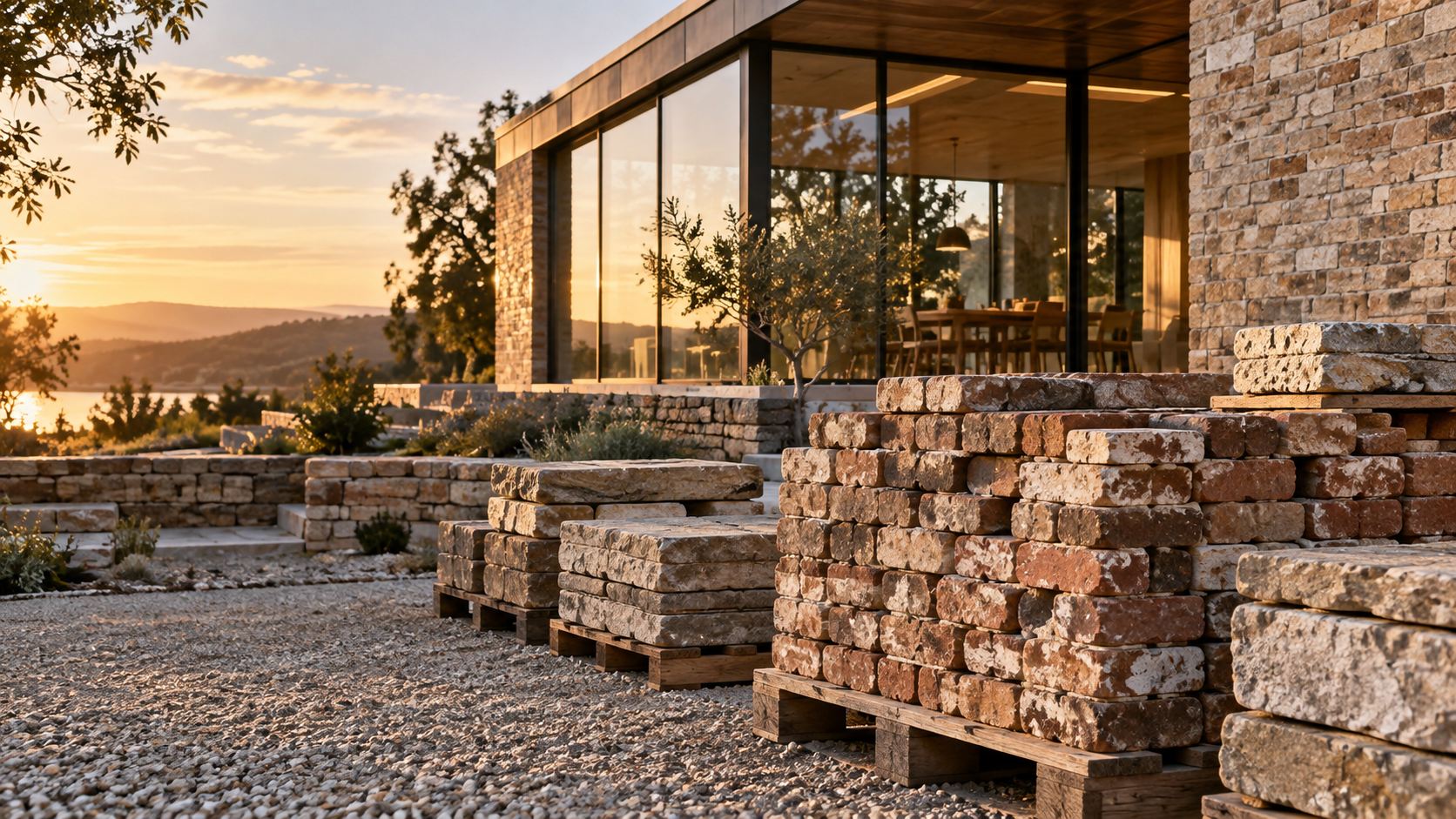
- Materials, such as reclaimed brick, stone, timber and steel, used again in new work.
A careful survey of the structure, materials, condition and history.
How we start
- Understand it. A careful survey of the structure, materials, condition and history. We never assume. See also Surveys and site investigation.
- Value it. What is special? What can be changed without loss? Heritage specialists often help.
- Test the options. Keep, adapt, extend or replace: we compare them for carbon, cost, function and character.
- Design the join. The meeting of old and new is where the design is won or lost.
- Plan for the unknown. Existing buildings hide surprises, so we leave room in the programme and budget.
The new and the old
Reuse does not mean preserving everything exactly. Sometimes a building needs a bold insertion to work again. At Müdrik, part of a historic building is carefully cut away and a glass atrium fills the gap, so that the old and the new can both be seen. See also New buildings in old streets.
Performance
Old buildings can be made comfortable and efficient. Insulation, better windows, new services and careful detailing can improve them a great deal, though some historic fabric needs a gentler approach. See also Operational energy.
When reuse is not the answer
Sometimes a building is unsafe, in the wrong place or too hard to adapt, and new construction is the better choice. We say so honestly. Even then, we reuse materials where possible and design the new building so that it can be reused later.
In short
Start with what is there. Understand it, value it and test the options before deciding to build new. See also Heritage conservation and Adaptive reuse and refurbishment.
Cite this article
Author: byJOOM. Choose a style and copy the citation.
- APA
byJOOM. (2026, October 15). Reuse before new build. byJOOM. https://byjoom.com/journal/reuse-before-new-build/
- Harvard
byJOOM (2026) Reuse before new build. Available at: https://byjoom.com/journal/reuse-before-new-build/ (Accessed: [date]).
- MLA
byJOOM. “Reuse before new build.” byJOOM, 15 Oct. 2026, byjoom.com/journal/reuse-before-new-build/. Accessed [date].
- Chicago
byJOOM. “Reuse before new build.” byJOOM, October 15, 2026. https://byjoom.com/journal/reuse-before-new-build/.