

All articles · · By byJOOM
New buildings in old streets: continuity and contrast
Most of the world's great streets were built over centuries. When we add a new building to one, we are joining a conversation that has been going on for a long time. The question is how to speak: copy what has been said, contradict it, or add something of our own that still belongs. This article looks at two of our concept designs, Hotel H in London and the Müdrik School of Architecture in Istanbul, and at the two ideas that guide them: continuity and contrast.
Three ways to build in an old street
- Imitate. Build something that looks old. It can feel safe, but it blurs the story of the street, and the copy is rarely as good as the original.
- Ignore. Build something that pays no attention to its neighbours. It may be striking, but it can break the street rather than add to it.
- Listen, then speak. Take what matters from the street, such as its height, rhythm, materials and light, and add a building that is clearly of its own time. This is the approach we take.
Within the third way there is a choice of emphasis. Sometimes we lean towards continuity, so the new building sits quietly in the line. Sometimes we lean towards contrast, so the new and old are clearly read side by side. Both are about respect.
Continuity: Hotel H, London
Hotel H is our concept for a new hotel that fills a gap in a historic London street, between stone buildings of different ages.
The new front is calm and clad in pale stone. Its horizontal lines follow the cornices and floor heights of the buildings beside it, and the rhythm of its bays and windows picks up the rhythm of the street. We did not copy a single detail. Bronze-toned vertical elements add depth and warmth, and give a modern reading of the classical idea of a base, a middle and a top.
At street level, a warm glazed entrance and planting bring the lobby to the pavement. Behind it, a courtyard garden brings green into the middle of the block, and a planted roof gives the building a soft crown above the parapets.
What makes it fit is not a style. It is proportion, materials and manners: it lines up with its neighbours, it uses stone as they do, and it behaves well on the street.
It can feel safe, but it blurs the story of the street, and the copy is rarely as good as the original.
Contrast: Müdrik School of Architecture, Istanbul
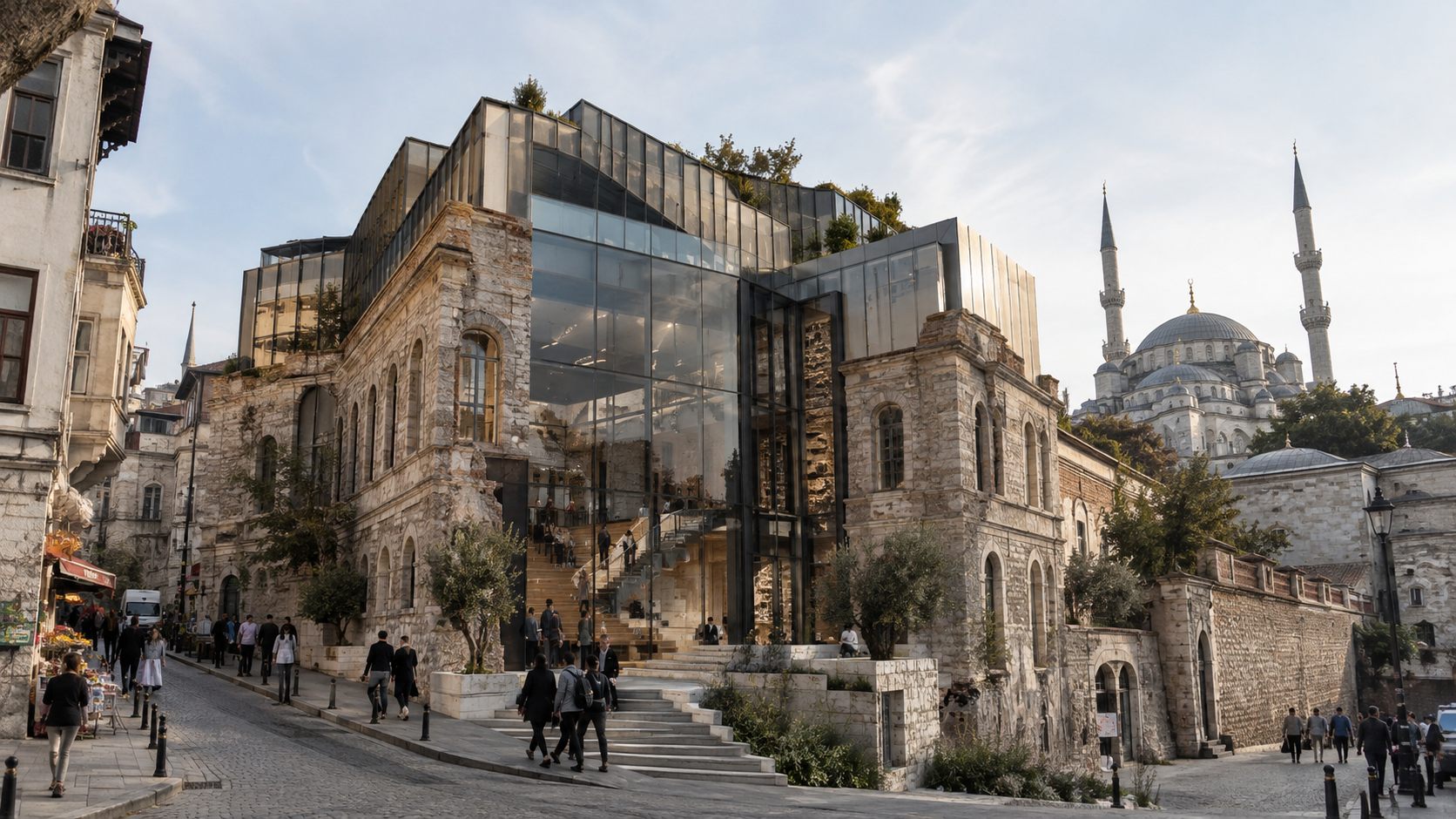
Müdrik is our concept for a school of architecture in the historic fabric of Istanbul. Here the idea is almost the opposite, though it comes from the same respect.
We keep a historic stone and brick building, with its arches, weathered masonry and domes and minarets of the skyline beyond. Then we carefully cut part of it away and fill the gap with a glass-walled atrium, suspended bridges and a stepped amphitheatre. The new glass, steel and timber do not pretend to be old. They are clearly of today.
The joint between old and new is deliberate and visible. Glass reveals the irregular edges of the retained masonry. New steel connections are slim and honest. A student walking through the building is always aware of two periods at once, which suits a school that teaches how to design in a layered city.
Here, contrast is a way of honouring the old. The historic stone is not hidden or copied. It is kept, cleaned of nothing but dust, and put on show.
What both have in common
Hotel H and Müdrik look very different, but they follow the same rules.
- They read the street first. Heights, lines, materials, colours and the way light falls.
- They add, they do not replace what matters. The old fabric that carries the character of the place is kept, or its character is carried forward.
- They are honest about their age. New work looks new and old work looks old. Neither pretends.
- They give something back. A warm lobby, a garden, an open atrium, a place for the public.
- They are well made. In old streets, careful detail matters even more, because the new building will be seen next to work built by hand.
We use the same principles in other places, such as Seven in Manchester, a stone-framed office building on a street of Victorian buildings, and The Common Ground in Liverpool, where pale limestone meets red-brick warehouses beside the dock.
Questions we ask before we draw
- What is special about this street, and what would be lost if it changed?
- What must be kept, and what can be added?
- Which lines, heights and materials should the new building share?
- Where should it be different, and why?
- Who will use it, and how does it improve the street for everyone else?
A note on approvals
Building in or near historic areas is closely regulated, and the rules differ in every country. Heritage authorities may need to be consulted at an early stage, and conservation specialists are essential. Hotel H and Müdrik are concept designs, and the images on our site are visualisations (see our Disclaimers). Any real project would need surveys, specialist advice and the agreement of the authorities.
See also: Heritage conservation, Adaptive reuse and refurbishment and Designing across borders.
Cite this article
Author: byJOOM. Choose a style and copy the citation.
- APA
byJOOM. (2026, October 15). New buildings in old streets: continuity and contrast. byJOOM. https://byjoom.com/journal/new-buildings-in-old-streets/
- Harvard
byJOOM (2026) New buildings in old streets: continuity and contrast. Available at: https://byjoom.com/journal/new-buildings-in-old-streets/ (Accessed: [date]).
- MLA
byJOOM. “New buildings in old streets: continuity and contrast.” byJOOM, 15 Oct. 2026, byjoom.com/journal/new-buildings-in-old-streets/. Accessed [date].
- Chicago
byJOOM. “New buildings in old streets: continuity and contrast.” byJOOM, October 15, 2026. https://byjoom.com/journal/new-buildings-in-old-streets/.