

All articles · · By byJOOM
Models: why we still build them
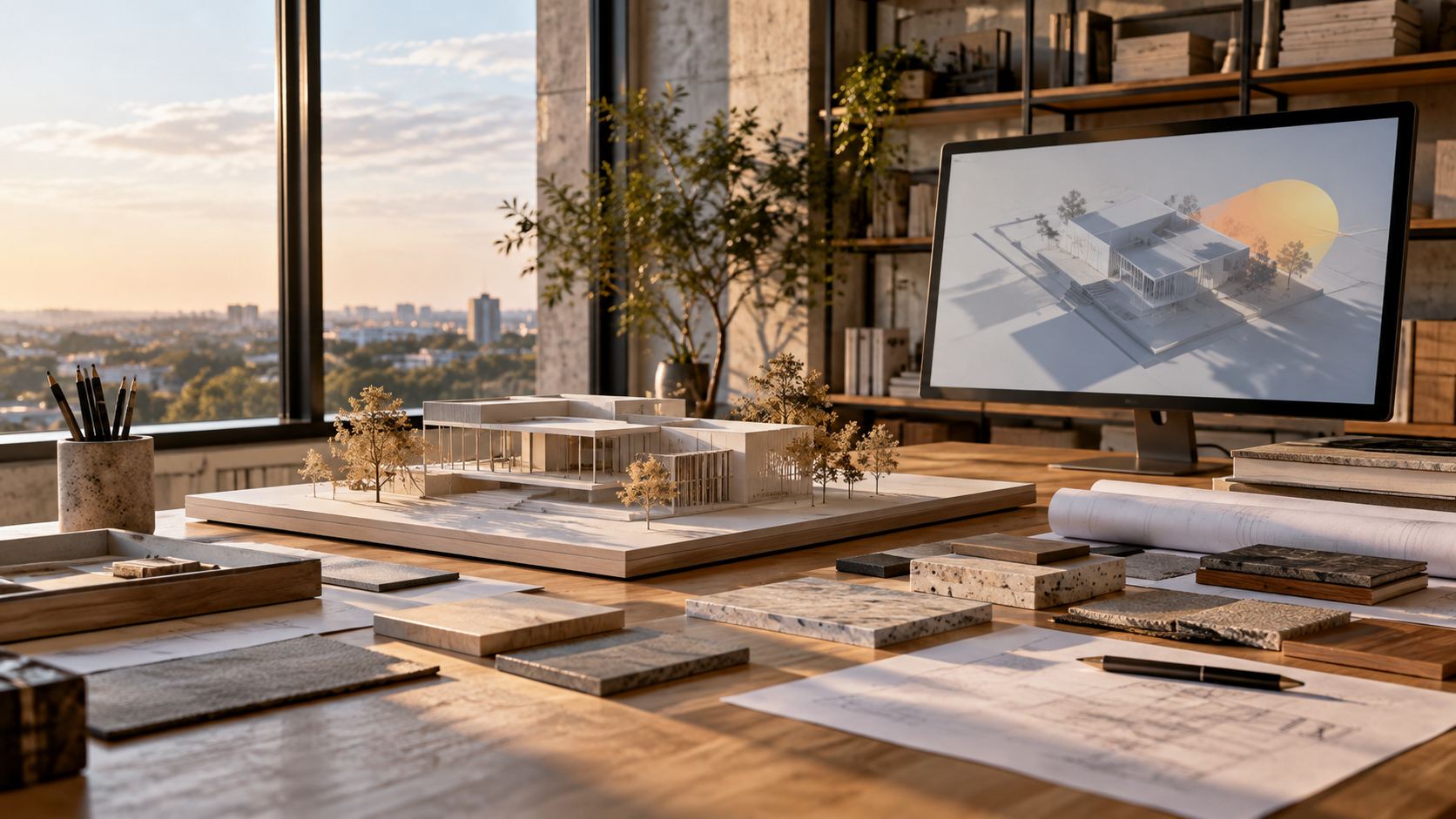
In an age of computer models, virtual reality and generated images, a studio table covered in card, balsa and glue can seem old-fashioned. We still build physical models. Here is why, and how they sit alongside the digital tools we also use. See also Drawing, then AI.
A model shows what a screen hides
On a screen, you see a building through a window, zoomed, rotated and rendered. On a table, you see the whole thing at once, in real light, from any side, at a scale your body understands. You can lean over it, put your finger on a roof, and see at a glance whether a courtyard is generous or tight, whether a tower is too heavy, how two buildings sit together. Many decisions are made faster and better this way.
Light and shadow
Put a white model by a window and watch the sun move across it. Shadows from overhangs, louvres and balconies fall as they will on the real building. This is a simple, honest test of whether a façade shades itself, and it teaches us more than many diagrams. See also Light.
On a screen, you see a building through a window, zoomed, rotated and rendered.
A shared language
A model needs no training to read. A client, a neighbour, a child or a planning officer can pick one up and understand it in a way a set of drawings does not allow. In meetings, a model on the table changes the conversation: people point, move around it and ask better questions.
Models at different scales
We use models for different jobs.
- Site models show the building in its setting, with its neighbours, streets and topography.
- Massing models are quick, simple blocks that test the overall shape.
- Concept models explore a single idea, such as a roof, a stair or a courtyard.
- Detail models at larger scale test a junction, a façade panel or a material.
- Interior models let us look into rooms at eye level.
Making teaches us
Cutting and gluing a model forces us to think about how things join. A roof that cannot be made as a model often cannot be built. Making also slows us down at the right moment, so we look more carefully.
Digital and physical together
Models do not replace computers. We often move between the two: sketch, digital model, physical print or cut model, back to the screen. Laser cutters and 3D printers let us make physical models from digital files, and photographs of physical models can be brought back into digital work. Each tool helps with what it does best.
Materials
Models can be made of card, timber, foam, plaster, clay or printed plastic. A white, abstract model concentrates attention on form and light. A model with real material samples, such as a piece of stone beside a piece of timber, helps judge colour and texture. See also Choosing materials.
Models keep a record
A finished model is an object of its own. It records an idea at a moment, and it makes a good gift to a client, a source of pride for the team and, years later, a reminder of how the design began.
In short
A model is a thinking tool, a communication tool and a craft. We expect to keep building them for as long as we design buildings.
Cite this article
Author: byJOOM. Choose a style and copy the citation.
- APA
byJOOM. (2026, October 15). Models: why we still build them. byJOOM. https://byjoom.com/journal/models-why-we-still-build-them/
- Harvard
byJOOM (2026) Models: why we still build them. Available at: https://byjoom.com/journal/models-why-we-still-build-them/ (Accessed: [date]).
- MLA
byJOOM. “Models: why we still build them.” byJOOM, 15 Oct. 2026, byjoom.com/journal/models-why-we-still-build-them/. Accessed [date].
- Chicago
byJOOM. “Models: why we still build them.” byJOOM, October 15, 2026. https://byjoom.com/journal/models-why-we-still-build-them/.