

All articles · · By byJOOM
Detail: why edges matter
From across the street, a building is a shape. Up close, it is a collection of edges: where wall meets floor, window meets stone, roof meets sky. The way those edges are drawn and made is often what separates a building that feels finished from one that does not. This article is about detail, and why it matters even when no one is looking at it.
Detail is where design meets the world
An idea on paper is clean. Rain, sun, tolerance, thermal movement, tools and human hands then act on it. Detail is the careful answer to those facts. A good detail does three things at once: it keeps the building working, it looks right and it can be built.
Edges tell you who cared
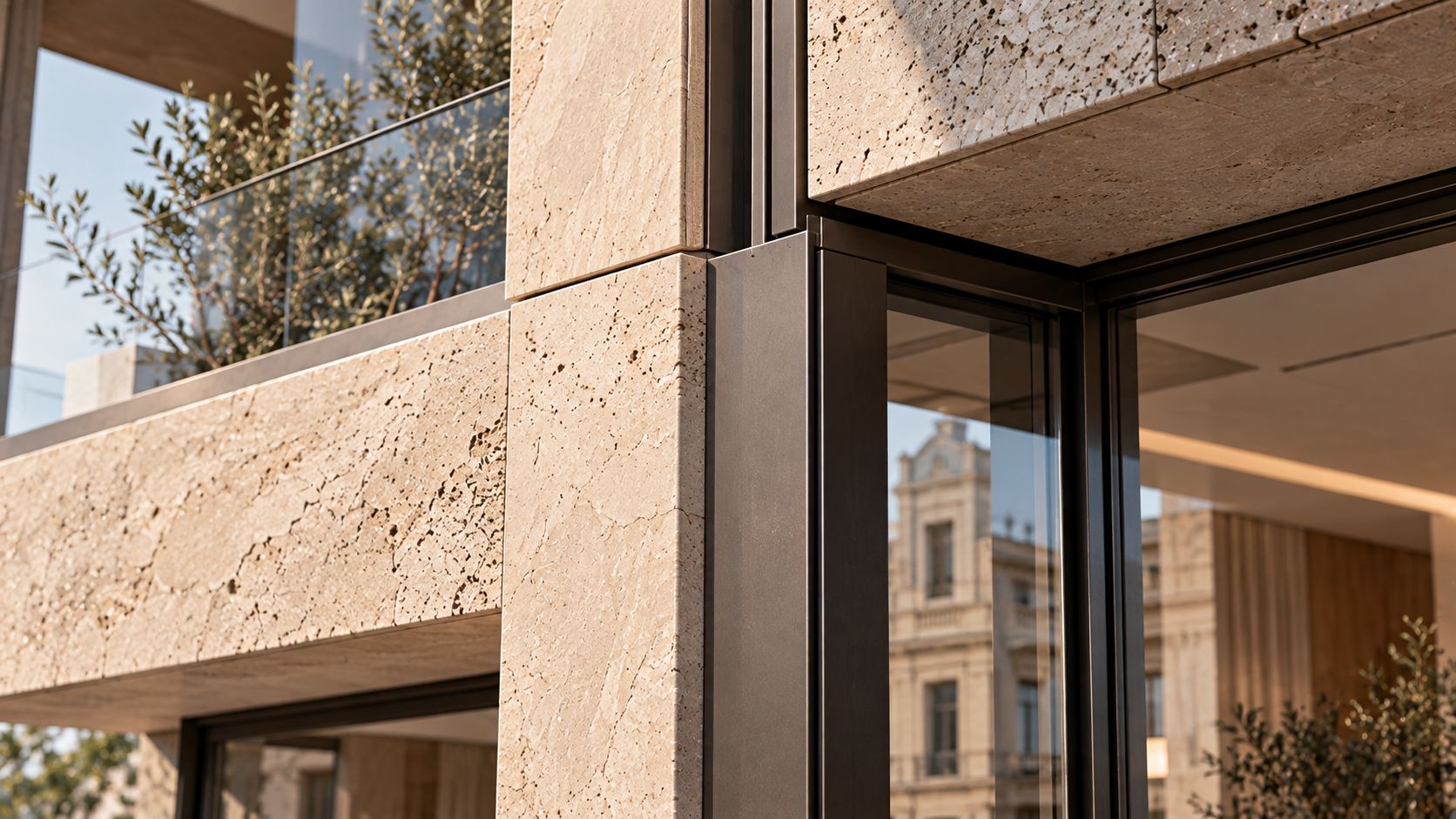
Look at where a stone panel meets a window frame, or where a wall meets the ground. A clean, shadowed joint tells you somebody thought about it. A messy seam, a patch of sealant or a crooked cut tells you nobody did. We spend a great deal of time on edges: the corners, the thresholds, the junctions between materials.
Rain, sun, tolerance, thermal movement, tools and human hands then act on it.
Shadow gaps and reveals
One of the simplest ways to make a clean edge is to leave a small, deliberate gap, a shadow gap or reveal, between two materials. It hides small errors, lets materials move and gives a crisp line of shadow. A deep window reveal in a stone wall, as in many of our concept designs, gives a façade depth and a sense of mass.
Water is the main enemy
Most building failures involve water. We detail so that water runs off and away: sloped sills, drips under projecting edges, drained cavities, concealed gutters that are still accessible. A building that sheds water well will last. See also Rain, brick and timber.
Movement
Buildings move: with temperature, moisture, load and settlement. Details that allow movement, with joints and slip layers, prevent cracks and leaks. A rigid detail in a moving building is a future problem.
Make it easy to build
A good detail is one that a builder can understand and make well. We try to keep details simple, with few different parts, tolerances that can be achieved on site and a logical order of work. Samples and mock-ups help us check. See also From sketch to site.
Make it easy to look after
We think about cleaning, repair and replacement. Can a window be washed? Can a damaged panel be changed without taking the wall apart? Details that can be maintained last longer.
Details at human scale
People touch handrails, door handles, stair edges, seats and sills. These deserve extra care, because they are felt as well as seen. A good handrail, a comfortable step and a warm timber edge make a building feel considered.
Detail and carbon
Good detail also helps reduce waste. Details that use less material, avoid unnecessary layers and allow parts to be repaired or reused lower the building's impact. See also Circular design.
In short
- Think about edges as much as shapes.
- Make details that keep water out and allow movement.
- Keep them simple enough to build well.
- Make them easy to look after.
- Take extra care where people touch.
Our concept designs are visualisations (see our Disclaimers), and a real project needs full technical design and specialist advice. See also Standards.
Cite this article
Author: byJOOM. Choose a style and copy the citation.
- APA
byJOOM. (2026, October 15). Detail: why edges matter. byJOOM. https://byjoom.com/journal/detail-why-edges-matter/
- Harvard
byJOOM (2026) Detail: why edges matter. Available at: https://byjoom.com/journal/detail-why-edges-matter/ (Accessed: [date]).
- MLA
byJOOM. “Detail: why edges matter.” byJOOM, 15 Oct. 2026, byjoom.com/journal/detail-why-edges-matter/. Accessed [date].
- Chicago
byJOOM. “Detail: why edges matter.” byJOOM, October 15, 2026. https://byjoom.com/journal/detail-why-edges-matter/.