

All articles · · By byJOOM
Façades: structure, skin and pattern
The façade is what most people see of a building, and the part that meets the weather, the sun, the street and the eye. It is also one of the hardest parts to get right, because it has to do so many jobs at once. This is how we think about it, with examples from The Jewel of Cleopatra, The Tower, AMTEC and Al Hikma Hospital.
What a façade has to do
- Keep the weather out. Rain, wind, heat, cold, dust and salt.
- Control the sun. Let in daylight and views, and keep out glare and heat.
- Let in air. Where the climate and use allow, open for fresh air.
- Hold itself up. Resist wind, support its own weight and move with temperature.
- Last. Look good and work for decades with reasonable care.
- Give the building character. Express what the building is for, where it is and who made it.
Structure and skin
A façade can be two things: the structure that holds the building up, and the skin that wraps it.
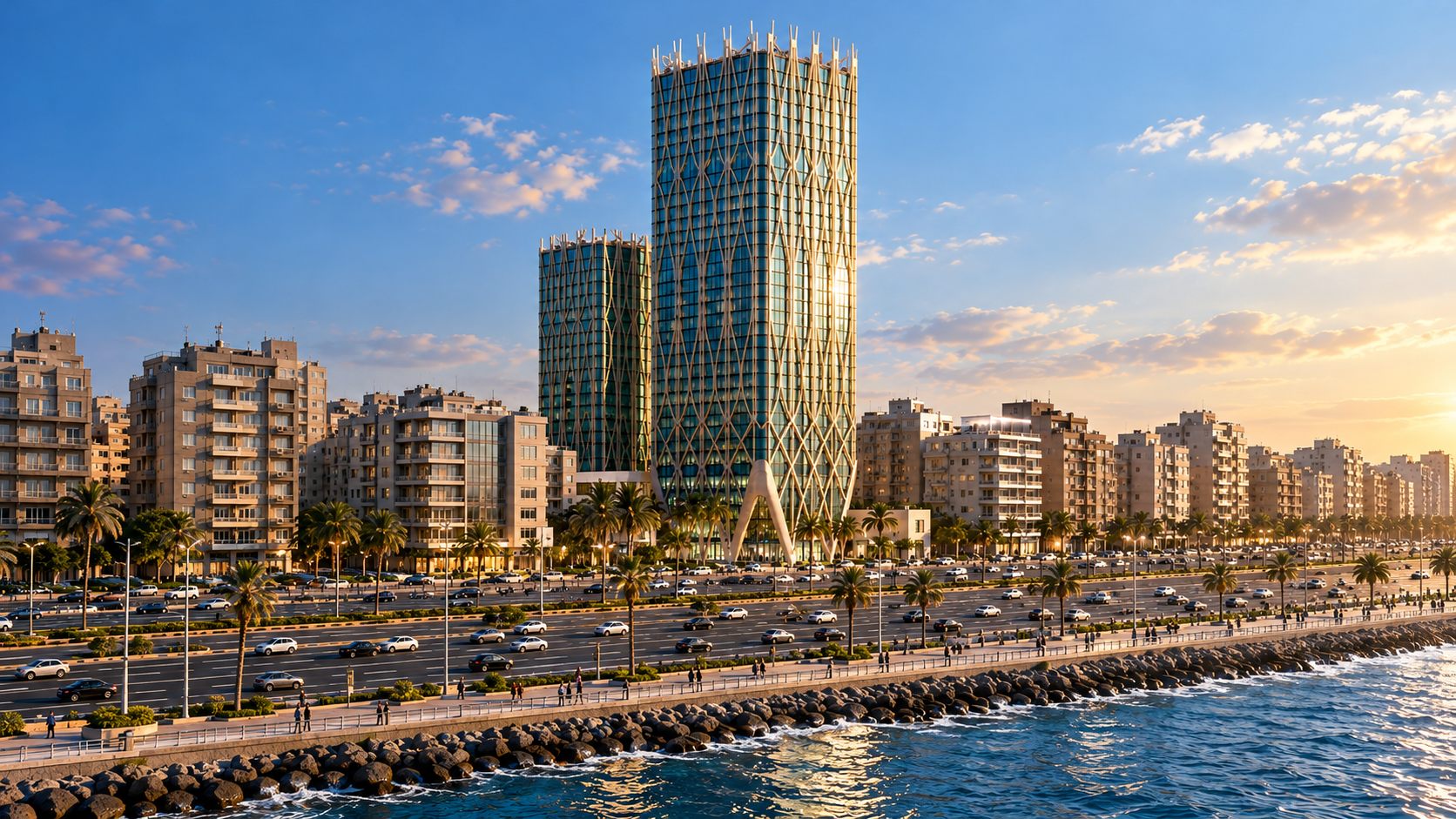
At The Jewel of Cleopatra and The Tower, a diagonal lattice, a diagrid, is both. It carries loads and gives the building its pattern, so that structure and image are the same. The glass behind is protected by the lattice, which also gives some shade. When the pattern earns its place by doing work, it feels honest.
A façade can be two things: the structure that holds the building up, and the skin that wraps it.
A second skin
At AMTEC, a second skin of closely spaced horizontal steel louvres sits outside the glazing. It shades the glass from the desert sun, filters light and throws a pattern of shadows. A second skin lets us have large glass areas and views without the heat. See also Designing for the desert.
A regular grid
At Al Hikma Hospital, a plain, regular grid of limestone piers, floor bands and deep bronze-framed windows gives a calm, durable, dignified front. Not every façade needs drama. A well-proportioned grid, made of good materials and detailed with care, can be beautiful and will not date.
Pattern with a reason
We like pattern that answers a need.
- A diagrid carries the structure.
- Louvres and fins give shade.
- Perforated screens filter light and give privacy.
- Planted terraces cool and soften.
- A deep window reveal gives shadow and depth.
Pattern with no purpose can look arbitrary, and we try to avoid it.
Proportion and rhythm
How tall and wide the openings are, and how they repeat, gives a façade its feel. We work on proportions with care, at every scale, from the whole elevation to a single window.
Detail and materials
A façade is only as good as its junctions and materials: how a window meets the wall, how stone is fixed, how water is shed. See also Choosing materials and Detail: why edges matter.
Made to be built
A façade must be buildable. We work with façade engineers, who check that panels can be made, transported, fixed and replaced, and that the whole system performs for its climate.
In short
A good façade is a wall that does work: it protects, shades, supports and expresses. Our concept designs, whose images are visualisations (see our Disclaimers), try to make each of those jobs visible.
See also: Façade engineering.
Cite this article
Author: byJOOM. Choose a style and copy the citation.
- APA
byJOOM. (2026, October 15). Façades: structure, skin and pattern. byJOOM. https://byjoom.com/journal/facades-structure-skin-and-pattern/
- Harvard
byJOOM (2026) Façades: structure, skin and pattern. Available at: https://byjoom.com/journal/facades-structure-skin-and-pattern/ (Accessed: [date]).
- MLA
byJOOM. “Façades: structure, skin and pattern.” byJOOM, 15 Oct. 2026, byjoom.com/journal/facades-structure-skin-and-pattern/. Accessed [date].
- Chicago
byJOOM. “Façades: structure, skin and pattern.” byJOOM, October 15, 2026. https://byjoom.com/journal/facades-structure-skin-and-pattern/.